The Asian citrus psyllid is a major pest during new-shoot periods of citrus crops, and it serves as the only natural vector for citrus Huanglongbing (HLB). Nicknamed "citrus cancer", Huanglongbing has no known curative treatment, and infected orchards can collapse within several years. This disease has occurred in 384 counties across 11 provincial-level regions in China. Driven by climate warming, the psyllid keeps expanding its distribution northward, creating an urgent pest-control situation.
1. Morphological Traits and Damage
Adults are approximately 3 mm long, grayish-green, with brown markings on forewings. At rest, they hold their abdomens tilted at a 45° angle against twigs - a key field identification feature. Nymphs are pale yellow, flat-oval, and produce white waxy filaments around their abdomen margins. Eggs are mango-shaped and orange-yellow.

Direct damage: Adults and nymphs cluster on young shoots and tender leaves to suck sap, causing shoot die-back and leaf deformation. Nymph-excreted honeydew triggers sooty-mold disease, impairing photosynthesis and fruit quality.
Indirect damage (the greatest threat): The psyllid acts as the sole natural vector of Huanglongbing. Both adults and nymphs can transmit the pathogen. The psyllid carrying the pathogen can transmit the disease throughout its life. They may acquire bacteria after feeding on infected trees for merely 30 minutes and become transmissible 7-25 days later. Host plants include rutaceous species such as citrus, pomelo, lemon, wampee, and orange jasmine.

2. Occurrence Patterns
It completes 6-14 generations annually (decreasing from south to north), overwintering as adults on leaf undersides. Overwintered adults resume activity when spring shoots flush, leading to heavily overlapping generations in the field. Three population peaks align with spring shoots (March-April), summer shoots (May-June) and autumn shoots (July-September), with autumn-shoot infestations being the most severe. Pest density on declining and HLB-infected trees can be over 10 times higher than on healthy trees. Prolonged rainy weather suppresses its reproduction.
Monitoring data: In 2025, in Shicheng County, Sichuan, average adult counts reached 11-13 per 100 autumn shoots, with maxima up to 150. In Xiangzhou, Guangxi, well-managed orchards averaged 30 adults per 100 shoots, while poorly-managed orchards hit 420. Poorly-managed orchards in Hezhou recorded 248-425 adults per 100 shoots. The Asian citrus psyllid was listed in China's National Class-I Crop Pest List in 2020.

3. Integrated Prevention-Control System
The core strategy focuses on blocking psyllid transmission plus eliminating HLB pathogen, combining ecological regulation, physical-chemical trapping, biological control and precise chemical intervention.
(1) Agro-ecological pest suppression
Implement unified shoot-flushing management. Use pruning and fertilization to synchronize new-shoot emergence and shorten vulnerable exposure periods. Remove late-autumn shoots to reduce overwintering food sources. Conduct orchard sanitation in winter-spring: eradicate rutaceous host plants (orange jasmine, wampee) inside and surrounding orchards, collect and dispose of pest-infested branches. Plant certified disease-free virus-free seedlings, adopt rational planting density, apply more organic fertilizers and avoid excessive nitrogen fertilizer to strengthen tree vigor.
(2) Physical-chemical trapping and monitoring
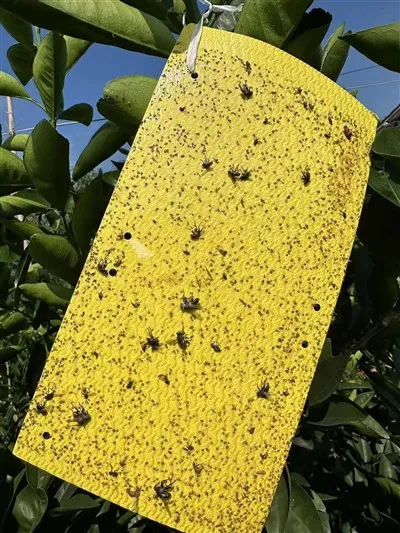
Hang 300-450 yellow sticky traps per hectare at 1.2-1.5 m height in the upper-middle tree canopy for adult trapping and population monitoring. Cover nurseries and young-tree orchards fully with 40-60-mesh insect-proof netting. Survey psyllid numbers on 100 shoots every 7 days. Initiate control when adult counts exceed 5 per 100 shoots in spring-shoot season, and trigger emergency control above 15 per 100 shoots in autumn-shoot season.

(3) Biological control
Conserve natural enemies: parasitoids such as Tamarixia radiata achieve 30%-50% parasitism rates; predators include ladybeetles, lacewings and spiders. Plant nectar-source plants such as Ageratum conyzoides to sustain beneficial insects, or release Anastatus wasps at 45 000-75 000 individuals per hectare in three separate releases. Under low pest pressure, deploy biopesticides including Metarhizium anisopliae, matrine and mineral oil.
(4) Targeted chemical control
Carry out orchard-wide synchronized sprays at three critical timings: spring-shoot emergence (2 cm shoot length), initial summer-shoot flush and autumn-shoot flush. Select registered active ingredients: pyriproxyfen, thiamethoxam, spirotetramat, bifenthrin. Combine fast-acting and long-residual products, mixing ovicides and contact insecticides; rotate modes-of-action to mitigate resistance. Thoroughly spray new shoots and leaf undersides, and enforce area-wide synchronized control. Apply systemic insecticides across the whole orchard 3 days before removing HLB-infected trees to stop pathogen-carrying psyllid dispersal. Strictly observe pre-harvest intervals to guarantee fruit safety.
Implementing the above integrated measures can effectively suppress psyllid populations, break the Huanglongbing transmission chain and secure the sustainable citrus-industry production.
Data Sources: Chinese agricultural technical specifications, field monitoring datasets from Guangxi and Sichuan citrus-growing regions, FAO citrus-pest references, China National Class-I Crop Pest Catalogue.