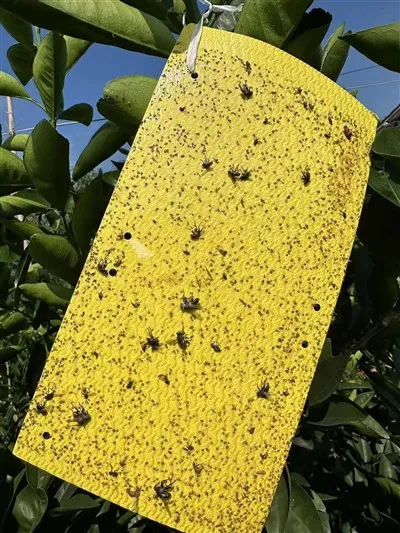
Diamondback moth (Plutella xylostella) belongs to Plutellidae of Lepidoptera. It is a cosmopolitan migratory pest distributed across China, ranking among the most destructive pests of cruciferous vegetables. Adults measure 6–7 mm in body length with a wingspan of 12–16 mm. Their forewings and hindwings are slender; when wings fold together, three connected diamond-shaped markings appear on the dorsal side. Eggs are oval and flat, about 0.5 mm long, pale yellow upon laying. The larva has 4 instars. Fully grown larvae are 10–12 mm long, pale green, spindle-shaped and tapered at both ends. When disturbed, they spin silk and dangle down. Pupae are 5–8 mm long, yellowish-green to greyish-brown, enclosed in a thin cocoon. Severe overlapping generations occur. In South China, 15–21 generations emerge per year, while 6–8 generations develop in the Yangtze-Huaihe Region. Peak outbreaks take place from March to June and August to November in southern China.

Diamondback moth larvae damage leaves of cruciferous vegetables. Newly hatched and 1st–2nd instar larvae feed only on leaf mesophyll while keeping the epidermis intact, forming transparent spots on leaves. 3rd–4th instar larvae create holes and notches. In severe cases, leaves are skeletonized. At seedling stage, larvae cluster on terminal leaves, hindering heading. On seed crops, they attack tender stems, young pods and seeds. A female moth lays an average of over 200 eggs, up to 600 at maximum. Hosts cover nearly all cruciferous vegetables including cabbage, cauliflower, Chinese cabbage, rapeseed, radish and mustard.

Yield losses caused by diamondback moth are substantial. Studies on economic thresholds of autumn cabbage at different growth stages show control is required at 0.54 larvae per plant at seedling stage, 0.91 per plant at rosette stage, 0.67 per plant at early heading stage and 6.08 per plant at mid-to-late heading stage (Journal from CQVIP). Flowering Chinese cabbage suffers heavy yield loss when infested at the 6–7 leaf or 7–9 leaf stage. Field surveys report an average pest density of 25–30 larvae per 100 plants in rapeseed fields, with a maximum of 85 larvae per 100 plants (Statistical data from Inner Mongolia Autonomous Region). The optimal temperature range for its development is 20–30℃. It prefers dry conditions; heavy rainfall suppresses its development. Continuous cropping of cruciferous vegetables or poor farm management favors heavy outbreaks.

Integrated Pest Management (referring to DB53/T 1083-2022 Technical Specification for Diamondback Moth Control on Cruciferous Vegetables)
Agriculture Control: Follow the policy "Prevention First, Integrated Management" and principle "Suppress adults, eliminate larvae; control pests early while young". Clear crop residues, fallen leaves and weeds immediately after harvest. Deep ploughing and soil solarization or flood irrigation kill residual pest sources. Reasonably arrange crop layout and avoid continuous cropping of cruciferous vegetables. Select smooth-leaf resistant varieties to reduce adult oviposition.
Physical and Biological Control: Install insecticidal lamps to trap adults by phototaxis, one lamp per 1–2 hectares. Cover greenhouses with 40-mesh or finer insect-proof nets to block adult invasion and oviposition. Use sex pheromones to trap male moths: place 45–90 diamondback moth pheromone traps per hectare, or deploy 450–600 mating disruption dispensers per hectare to interfere with mating. For biological control, natural enemies such as Diadegma semiclausum can be released. At young larval stage, apply biocontrol agents including Bacillus thuringiensis (Bt), Burkholderia pyrrocinia, diamondback moth granulovirus, matrine, Beauveria bassiana and Metarhizium anisopliae.
Chemical Control: Apply pesticides at the critical period from peak egg hatching to young larvae (before 3rd instar). Rotate broflanilide, spinosad, spinetoram, chlorfenapyr, indoxacarb, emamectin benzoate and abamectin. Ovicide agents such as lufenuron and pyriproxyfen may be combined to extend efficacy. Add organosilicon adjuvants to improve control performance. Notably, diamondback moth develops pesticide resistance faster than most pests. Repeated use of a single insecticide must be strictly avoided; alternate chemicals with different modes of action. Pyrethroid pesticides shall be applied at most once per year. Apply pesticides at dosages specified in the specification, observe pre-harvest intervals to guarantee vegetable safety.
Data sources:
CQVIP journals
Inner Mongolia agricultural field survey
DB53/T 1083-2022 Technical Specification for Diamondback Moth Control on Cruciferous Vegetables