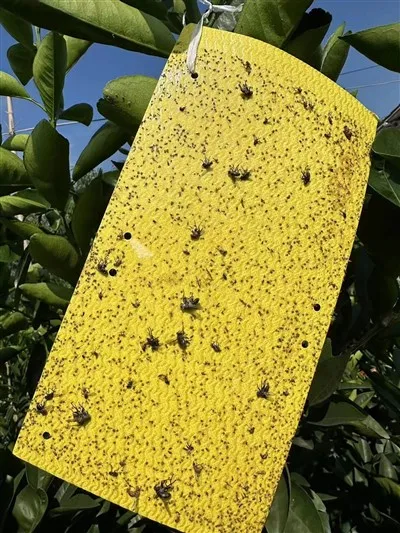
Insect sticky traps are a green physical pest control tool that exploits insects' color preferences. They offer advantages such as low cost, no pollution, safety for humans and livestock, and ease of operation. They are widely used for green pest control in various crops, including Chinese medicinal herbs, fruit trees, vegetables, and tea plantations. So, how do you choose the right sticky trap for different pests? We have conducted many experiments to verify this. Today, we will share one of these experiments.
In 2019, in collaboration with the Qianwei County Agriculture and Rural Bureau and the Leshan City Seed Station in Sichuan Province, we conducted a four-month trial (June–September) in a medicinal herb planting area. We used CMYK printing and color matching technology to produce 25 sticky traps of different colors. These traps were evenly placed in the experimental area. Every seven days, we recorded the species and number of pests on each sticky trap and replaced them with new ones.

Our experiment found that, in terms of total numbers, Thripidae, Cecidomyiidae, and Chrysomelidae were the most captured pests. Among the traps, Trap No. 1 had the best trapping effect on Thripidae, capturing an average of 396 individuals per trap. Trap No. 14 worked best for Cecidomyiidae, with an average of 208 individuals per trap. Trap No. 7 was most effective for Chrysomelidae, capturing an average of 53 individuals per trap.

In addition, the sticky traps also captured many household pests. Traps No. 1 and No. 15 trapped 383 and 353 individuals per trap of Ceratopogonidae, respectively. Traps No. 2 and No. 9 were most effective for Culicidae, each capturing 24 individuals per trap. Traps No. 12 and No. 23 captured an average of 25 and 24 individuals per trap of Muscidae, respectively.

Through experimental verification, sticky traps have proven to play a very positive role in both agricultural pest control and management of household pests. With scientific and rational combinations, they enable precise control of various pests, reduce dependence on chemical pesticides, and protect the ecological balance in the field. Sticky traps can certainly become your "good helper"!
The above experimental results have been published in * Plant Health and Medicine * under the title "The Attractive Effects of 25 Different Colors of Insect Sticky Traps on Tetradium ruticarpum Pests".