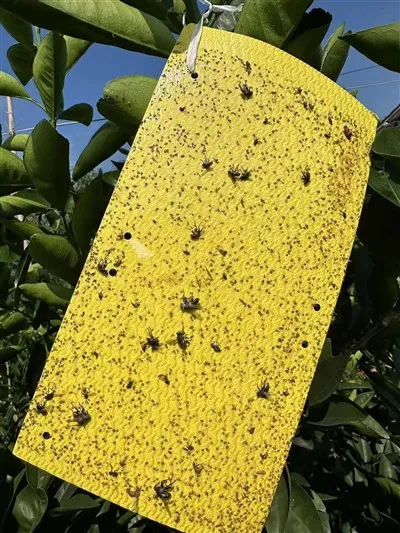
Choosing the best insect sticky trap depends on your target pests, application environment, adhesive performance, material quality, and product specifications. For commercial buyers, the right sticky trap should provide reliable insect monitoring, consistent adhesive performance, and suitable durability for its intended application.
For wholesalers, distributors, and agricultural product importers, selecting a reliable insect sticky trap manufacturer is equally important. Factors such as MOQ, wholesale pricing, OEM customization, quality control, and delivery capacity can directly affect your purchasing costs and long-term business performance.
What Types of Insect Sticky Traps Are Available for Different Pest Control Applications?
Yellow and blue are the two most widely used colors for insect sticky traps, primarily for monitoring aphids(Aphididae), whiteflies(Aleyrodidae), and thrips(Thysanoptera). While these remain the standard choices in agricultural applications, some manufacturers also offer pink, green, and black sticky traps for more specific pest monitoring needs.
In practical applications, pink sticky traps have also proven effective for capturing thrips. Green traps can be used to monitor Chinese citrus fly(Bactrocera minax), while black sticky traps are used for tomato leafminers(Tuta absoluta). For buyers sourcing sticky traps for different crops or pest control programs, choosing the right color can help meet specific monitoring requirements.
Yellow vs. Blue Insect Sticky Traps: Which One Should You Choose?
Yellow sticky traps: Commonly used for monitoring aphids, whiteflies, and other flying agricultural pests.
Blue sticky traps: Widely used for thrips monitoring.
Pink sticky traps: Another option for capturing thrips in practical applications.
Green sticky traps: Used for monitoring Chinese citrus fly.
Black sticky traps: Used for monitoring tomato leaf miners (Tuta absoluta).

Although yellow and blue account for most demand in the agricultural sticky trap market, offering additional colors can help distributors and agricultural suppliers serve customers with more specialized pest monitoring requirements.
Different Shapes and Designs of Sticky Traps
For most agricultural applications, including greenhouses, orchards, and open-field crops, rectangular sticky cards are the standard choice. Their simple design makes them practical for hanging, positioning, and replacing during routine pest monitoring.

Two commonly preferred sizes are 20 × 25 cm and 25 × 30 cm, which are suitable for many agricultural applications.
In European and North American markets, insect sticky traps are also used in home gardens and for indoor potted plants. Consumers in these settings often prefer smaller rectangular cards or custom-shaped traps that fit different plant arrangements and available spaces.

For wholesalers and distributors, offering a range of colors, sizes, and shapes makes it easier to serve both commercial agricultural customers and the home gardening market.
Which Material and Adhesive Performance Should Wholesale Buyers Look For?
The backing material and adhesive formulation are two of the most important factors affecting the performance, durability, and cost of insect sticky traps. Most conventional sticky traps on the market use polypropylene (PP) plastic as the backing material, mainly because paper-based alternatives generally cost more. However, the best material choice depends on the intended application, particularly when pheromones or environmentally friendly disposal options are involved.
Adhesive quality is equally important. For sticky traps used in greenhouses, orchards, and open-field environments, the adhesive must withstand high temperatures, UV exposure, oxidation, and moisture without melting, running, or losing its tackiness. Wholesale buyers should evaluate both the backing material and adhesive performance before placing bulk orders.
Paper vs. Plastic Insect Sticky Traps: A Material Comparison
PP Plastic: The Mainstream Choice for Agricultural Sticky Traps
Polypropylene (PP) is currently the most widely used backing material for conventional insect sticky traps. One of the main reasons is cost efficiency, as paper-based materials generally have a higher production cost.
PP plastic provides a practical backing for standard sticky cards used in greenhouses, orchards, and field crops. It is suitable for most conventional insect monitoring applications where pheromone absorption is not required.
Paper-Based Materials: Suitable for Pheromone-Integrated Traps
Paper offers an important advantage: its ability to absorb and retain pheromone formulations. This makes it suitable for specialized products that combine sticky traps with attractants, such as fruit fly pheromone sticky traps.
For these products, the backing material is not simply a support for the adhesive. Its absorption properties also play a role in the delivery and performance of the pheromone.
Biodegradable Materials: An Emerging Option
In recent years, biodegradable sticky trap materials have been developed in the Chinese market, primarily using corn starch and nonwoven fabric.

According to the material development and application information, these backing materials can be buried in soil after use and naturally decompose within approximately six months. Their decomposition products do not adversely affect the growing environment.

This provides an alternative for agricultural users looking to reduce the amount of conventional plastic waste generated by routine pest monitoring.
Why Adhesive Quality Matters in Sticky Traps
The adhesive is a critical component of an insect sticky trap. It determines how well the trap captures insects, how long it remains effective, and how easy it is to handle during installation and replacement.
For outdoor agricultural applications, adhesive performance needs to be evaluated under several conditions.
1. High Melting Point and Temperature Resistance
Sticky trap adhesives should have a sufficiently high melting point to withstand elevated temperatures. If the adhesive softens excessively in hot weather, it may melt or run across the trap surface.
This can make the product messy and difficult to handle, while reducing its effective service life. A heat-resistant formulation helps maintain adhesive stability during use.
2. Oxidation Resistance
Prolonged outdoor exposure can accelerate adhesive aging through oxidation. As the adhesive deteriorates, its ability to retain tackiness may decrease.
Adding suitable antioxidants to the adhesive formulation helps slow down oxidation and maintain performance over a longer period.
3. UV Resistance
Agricultural sticky traps are often installed in locations exposed to direct sunlight. Continuous UV exposure can affect adhesive stability and shorten the product's service life.
UV-resistant ingredients are therefore important for traps intended for outdoor use, particularly in orchards and open-field growing environments.
4. Water Resistance
Rainfall and high humidity can also affect adhesive performance. A good-quality adhesive should retain its tackiness even after being exposed to rain or water splashing.

For buyers sourcing sticky traps for outdoor agricultural applications, water resistance is an important factor when comparing different adhesive formulations.
When evaluating suppliers, buyers should ask how the adhesive performs under heat, sunlight, oxidation, and moisture exposure rather than relying solely on general claims such as "strong adhesion" or "long-lasting glue."
How to Choose a Reliable Insect Sticky Trap Manufacturer and Wholesale Supplier?
Choosing an insect sticky trap manufacturer involves more than comparing product prices. For importers, wholesalers, and agricultural supply distributors, production capacity, quality control, minimum order quantities, and customization options all play an important role in supplier selection.
Most established insect sticky trap manufacturers now operate automated production lines that handle multiple stages of production, including adhesive melting, coating, cutting, and packaging. A standard, well-established automated production line can produce approximately 80,000 rectangular sticky traps(20*25 cm) per day under normal operating conditions. This level of automation improves production efficiency and gives buyers a clearer indication of a manufacturer's ability to handle large-volume orders.
Check the Manufacturer's Production Capacity and Quality Control
1. Evaluate Production Equipment and Manufacturing Capacity
Automated production equipment is an important indicator of a manufacturer's production capabilities. A complete production line can automate adhesive melting, coating, cutting, and packaging, reducing manual handling and improving production consistency.
Under normal operating conditions, a mature automated production line can produce approximately 80,000 rectangular sticky traps(20*25 cm) per day. For importers and distributors purchasing in bulk, this capacity is particularly important when evaluating whether a supplier can meet order volumes and maintain reliable delivery schedules.

If you require custom-shaped insect sticky traps rather than standard rectangular cards, check whether the manufacturer also has die-cutting equipment and the necessary tooling to produce different shapes. Not every factory specializing in standard sticky cards has the equipment required for customized designs.
2. Review the Manufacturer's Quality Inspection Process
A reliable manufacturer should have a structured quality control process covering incoming raw materials, pre-production inspections, and finished product sampling.
Incoming Material Inspection: Random checks of incoming backing materials, focusing on color consistency and potential color variations between batches.
Pre-Production Inspection: Verification of material color and consistency before production begins, helping prevent color differences in finished products.
Finished Product Inspection: Random sampling to check adhesive coating uniformity and adhesive performance.
3. Understand How Adhesive Tackiness Is Tested
Adhesive performance is one of the most important quality indicators for insect sticky traps. In China, a commonly referenced national-standard test method uses a 5 g weight to evaluate adhesive tackiness(GB/T 24689.4-2009 Equipment for crop protection - Insect adhesive board).

Under this test procedure, a 5 g weight is placed naturally on the sticky surface. The trap is then slowly turned over, and the weight must remain attached without falling off for at least five minutes.

For overseas buyers, understanding the manufacturer's adhesive testing procedure helps make supplier evaluations more objective. It is also worth asking for actual test records and confirming the testing method used when comparing products from different factories.
Compare MOQ, Wholesale Pricing, and OEM Customization
1. Check the Minimum Order Quantity (MOQ)
MOQ directly affects purchasing flexibility and inventory planning. Importers and wholesalers should confirm the minimum order requirements for standard products as well as customized orders before making a purchasing decision.
2. Compare Wholesale Pricing and Long-Term Supply Costs
Unit price is an important factor, but it should not be the only consideration. Buyers should evaluate pricing against product specifications, adhesive quality, production capacity, and order quantities.
Competitive bulk pricing combined with consistent product quality can help importers and distributors maintain healthy profit margins and build sustainable long-term business relationships.
3. Discuss OEM Packaging and Private Label Services
If you plan to sell insect sticky traps under your own brand, discuss packaging design and customization with the manufacturer before placing an order.
OEM arrangements may include branded packaging, logo printing, and customized product presentation. Agreeing on packaging requirements early helps ensure that the finished products are ready for your target market and distribution channels.
What Should Buyers Consider Before Purchasing Insect Sticky Traps in Bulk?
Before contacting an insect sticky trap manufacturer or wholesale supplier, buyers should have a clear understanding of the pests they need to monitor and the environment in which the traps will be used. These details help determine the most suitable trap color and backing material for the intended application.
If you have specific customization requirements, discuss the key order details with the supplier in advance. These may include the minimum order quantity (MOQ), packaging specifications, and expected purchase volume. Clarifying these requirements early helps both parties assess whether the order is feasible and align on the details before production begins.
Whenever possible, consider purchasing a small quantity of samples for testing before placing a bulk order. Testing the traps under your actual application conditions allows you to evaluate whether the product meets your requirements and make a more informed purchasing decision.
FAQ
Q: What is the best insect sticky trap?
A: The best insect sticky trap depends on the target pest and application. Yellow traps are commonly used for monitoring whiteflies, aphids, and leafminers, while blue traps are commonly used for thrips monitoring. In addition, there are also green, pink and black sticky traps.
Q: Are plastic insect sticky traps better than paper sticky traps?
A: Plastic sticky traps generally offer better moisture resistance and durability, depending on the material. The conventional insect sticky trap usually use plastic as the base material.
Q: What should I look for when choosing an insect sticky trap manufacturer?
A: Check the manufacturer's production capacity, adhesive quality, material options, MOQ, OEM services, quality control procedures, and delivery reliability.
Q: Can I order custom insect sticky traps in bulk?
A: Yes. Many manufacturers offer OEM customization, including product dimensions, colors, adhesive specifications, logo printing, and packaging, subject to MOQ and production requirements.