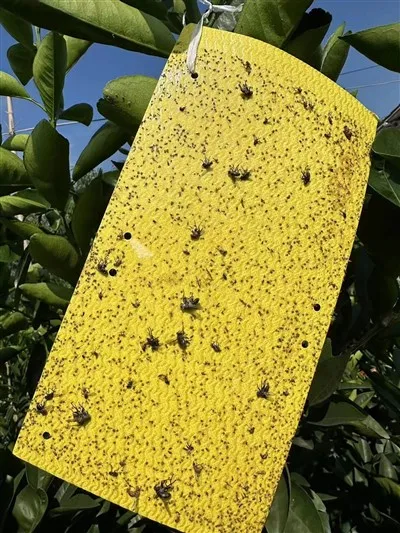
The Asian Citrus Psyllid(Diaphorina citri) is a common pest of citrus plants. The Huanglongbing (citrus greening disease) that is spread by it is regarded as the "terminal illness" of the citrus industry.
Characteristics of the Asian Citrus Psyllid
The Asian citrus psyllid belongs to the order Hemiptera, family Psyllidae, and is also known as the oriental citrus psyllid.
Eggs: Pale yellow, mango-shaped, with a short stalk at the tip, transparent and glossy. The female lays eggs in the crevices of young shoots or on tender leaves; no eggs are laid in the absence of young shoots or leaves.
Nymphs: Five instars. Flattened, oval-shaped, slightly raised on the back, pale yellow in color. Often clustered on young shoots, with white waxy filaments typically secreted around the edge of the abdomen.
Adults: Small in size, about 3 mm long. Grayish-yellow in body color, densely covered with brown spots. When at rest, the tip of the abdomen is raised at a 45-degree angle to the resting surface. Adults typically feed and rest on the young shoots and tender leaves.

Other features

Damage Caused by the Asian Citrus Psyllid
The Asian citrus psyllid is an important pest of citrus crops. Both adults and nymphs use their piercing-sucking mouthparts to feed on young shoots, tender leaves, and new buds, causing the shoots to wither and shrink, and the new leaves to become malformed and twisted, severely affecting plant growth.

The psyllid lays eggs in the crevices of host plant shoots and buds. Adults and nymphs suck sap from young shoots; when severely infested, the host shoots wilt and become distorted. The nymphs excrete large amounts of white, waxy honeydew, which adheres to the branches and leaves and readily induces sooty mold, further weakening the plant's photosynthesis. Once adults find a feeding site, they generally feed and do not move throughout the day, showing no clear preference for leaf age. The leaves that are fed upon often turn yellow, wither, and become twisted.

The Asian citrus psyllid is the only natural vector of Huanglongbing (citrus greening disease). Once the psyllid enters a citrus orchard, the infection rate of Huanglongbing can surge to over 80% within one to two years, resulting in total crop failure, premature tree decline, and even complete orchard loss.