The striped flea beetle (Phyllotreta striolata), belongs to the Chrysomelidae family under Coleoptera. It is a global major pest of Cruciferous vegetables, widely distributed in vegetable-growing areas across northern and southern China, with particularly severe outbreaks in South China. It has become one of the most difficult vegetable pests to control in leafy vegetable production. Adults measure 1.5-2.8 mm in size, featuring a metallic blue-black body with distinctive curved yellow longitudinal stripes in the middle of each elytron. They jump rapidly when disturbed and exhibit feigning death behavior. Both adults and nymphs cause crop damage with severe generation overlapping. The pest reproduces 4-8 generations per year, forming two damage peaks in spring and autumn, with the highest population density occurring from October to December and February to May. Females lay eggs in moist soil crevices around vegetable roots. Larvae feed on root systems at a soil depth of 3-4 cm and pupate underground, resulting in dual above-ground and underground damage: adults consume foliage while larvae destroy roots. This unique living habit creates a common control dilemma, as adult pests are difficult to eliminate on leaves and underground larvae survive conventional spraying.

Its primary hosts include Cruciferous vegetables such as flowering Chinese cabbage, pakchoi, cabbage, radish and mustard. When food sources are insufficient, the pest will infest a small number of melon and Solanaceous crops. Adults gnaw young leaves, leaving dense pinhole-like perforations that hinder normal growth; severe feeding on seedling growing points leads to direct plant death. Larvae strip root bark and bite off fibrous roots, causing blemishes on fleshy roots. Damaged root systems result in above-ground wilting and plant death. Root wounds also induce secondary bacterial diseases including soft rot and black rot, further aggravating yield losses.

According to pest monitoring bulletins released by the Guangdong Department of Agriculture and Rural Affairs, heavily infested fields can host up to 4,000 adults per hundred plants, with plant damage rates reaching as high as 92%. Field studies conducted by Zhejiang Academy of Agricultural Sciences show that flea beetle-infested vegetable fields generally suffer yield losses of over 30%. Severe seedling-stage outbreaks cause high seedling deficiency rates and even total crop failure requiring reseeding. Systematic field monitoring in Shenzhen records plant damage rates of 55.5%-70% during peak occurrence periods, with 90-140 adults per hundred plants. Radishes are more severely damaged than other vegetables such as Chinese cabbage and flowering cabbage.

This pest persistently threatens suburban vegetable bases. Fields with high multiple cropping indexes and continuous Cruciferous vegetable cultivation suffer significantly heavier infestations. Long-term unreasonable pesticide application has resulted in high-level pest resistance in many regions, further increasing control difficulties.
Integrated Pest Control Technologies (Based on DB4403/T 431-2024)
1. Agricultural Control
Select suitable seasonal vegetable varieties and implement standardized scientific cultivation management in accordance with variety requirements. Timely remove crop residues, weeds and waste plastic films after harvest, followed by deep tillage and sun drying of field beds. Apply quicklime for field disinfection at a dosage of 750 kg to 1500 kg per hectare, evenly spreading on the soil surface before thorough tillage and soil mixing. Establish scientific crop rotation systems, including paddy-upland rotation and rotation with non-Cruciferous crops to break pest circulation.
2. Physical and Biological Control
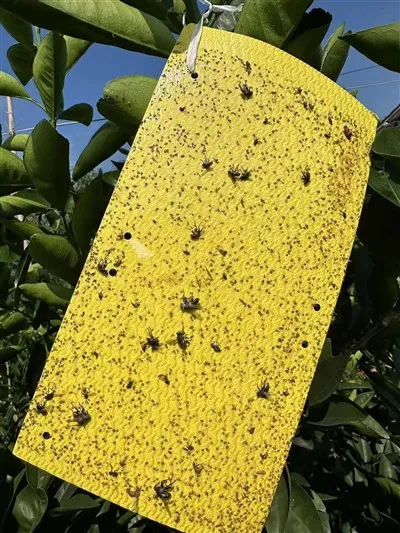
Kill underground eggs, larvae and pupae through high-temperature flame soil treatment and high-temperature soil sealing to reduce overwintering and seasonal pest populations. Adopt small arch shed insect-proof net isolation, and deploy pheromone sticky traps for continuous adult monitoring and trapping. Apply biological agents such as Bacillus Thuringiensis and Metarhizium Anisopliae to sustainably suppress adult population density.
3. Chemical Control
Implement synchronous management for above-ground adults and underground larvae. For soil treatment before transplanting or during the seedling stage, apply Dinotefuran or Clothianidin granules via broadcasting or hole placement to eliminate underground larvae. Conduct foliar spraying targeting adult pests by rotating approved insecticides including Broflanilide, Acetamiprid and Pyridaben. Apply strictly according to standardized dosages and comply with pesticide safety pre-harvest intervals. Rotate insecticides with different modes of action to delay resistance development. Arbitrary dosage increase and frequent repeated spraying are prohibited to ensure vegetable product safety and quality.
Data Sources
This guide is formulated in accordance with local standard DB4403/T 431-2024, combined with field pest monitoring data from Guangdong Department of Agriculture and Rural Affairs, crop loss research from Zhejiang Academy of Agricultural Sciences, and systematic field monitoring results from Shenzhen vegetable planting areas.