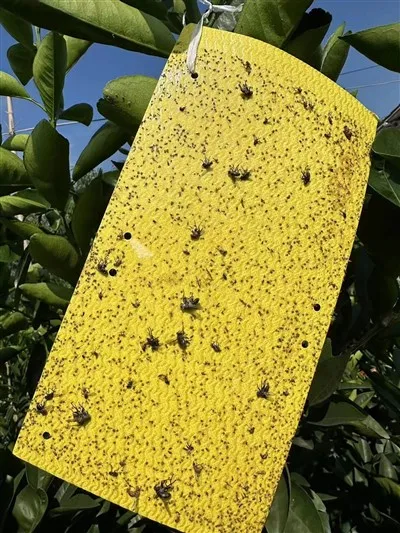
There is a famous ancient Chinese idiom: "a moth darting into a flame." It describes the behavior of moths flying towards fire, confirming that people discovered the phototaxis of some insects thousands of years ago. Throughout Chinese history, there are also records of our ancestors using fires to trap and kill insects.

Why are insects attracted to light? Scientists have conducted extensive exploration and research on this question. Various hypotheses have been proposed, such as the Light Compass Orientation Hypothesis, Light Antenna Hypothesis, Visual Interference Hypothesis, and the Light Stress Hypothesis. To this day, the exact principle has yet to be definitively determined.

However, the stagnation in theoretical research has not hindered practical application. In the 1930s, the first pest control experiments using black lights were conducted in the United States, marking the birth of the modern insect killer lamp. With technological development, today's insect killer lamps are constantly evolving.

After nearly a century of development, insect-killing lamps have become a crucial part of green agricultural pest control. The use of these lamps can significantly reduce the application of chemical pesticides, slow down the development of pesticide resistance in pests, and effectively decrease pesticide residues. Moreover, the harm they cause to beneficial insects is far lower than that of chemical pesticides.
Agriculture is the foundation of human development. As technology continues to advance, this small lamp may yet illuminate more unknown possibilities for the integration of life, ecology, and technology, lighting the way forward for agricultural development.