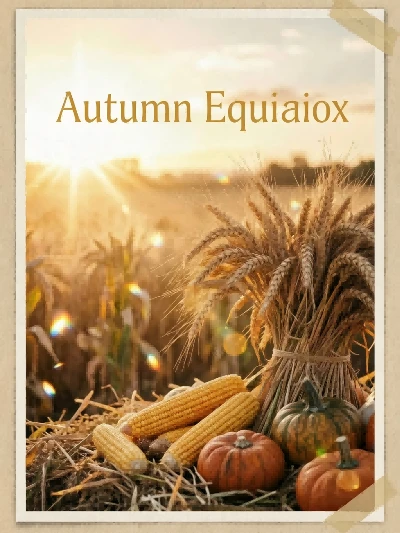
The Autumn Equinox is the sixteenth of the 24 Solar Terms and the fourth solar term of autumn. It falls on September 22 or 23 in the Gregorian calendar each year, beginning when the sun reaches the celestial longitude of 180°. The term has two meanings: first, on this day the sun shines directly over the equator, and day and night are equal across the globe; second, the Autumn Equinox lies in the middle of autumn, dividing the entire autumn season into two equal halves. As the Chunqiu Fanlu (Luxuriant Dew of the Spring and Autumn Annals) says: "At the Autumn Equinox, yin and yang are in balance; therefore day and night are equal, and cold and heat are balanced."
For agricultural production, the Autumn Equinox is a key juncture linking what comes before and what follows. At this time, the busy "three autumns" season-autumn harvesting, autumn plowing, and autumn sowing-is in full swing, with all three proceeding simultaneously. Everywhere in the fields there is a bustling scene of rush harvesting and rush sowing. It is precisely for this reason that many traditional customs of the Autumn Equinox revolve closely around agricultural activities, reflecting farmers' hopes for a bountiful harvest and their reverence for the land.
During the Autumn Equinox, most parts of the country enter the peak of autumn harvest. In the south, rice, and in the north, corn, soybeans, and other autumn grain crops mature one after another and await harvesting. In cotton fields, cotton bolls are opening, and tobacco leaves are turning from green to yellow-an excellent time for harvest. Meanwhile, the sowing of winter wheat has also reached a critical window. In North China, a farming proverb circulates: "White Dew is too early, Cold Dew is too late; the Autumn Equinox is just the right time to sow wheat." This clearly identifies the Autumn Equinox as the best time to sow winter wheat. In the Jiangnan region, there is a saying: "When the Autumn Equinox weather brings white clouds, songs are heard everywhere as rice is planted," reflecting that this is also a suitable period for planting rice.
The urgency of farm work at the Autumn Equinox is also reflected in the high sensitivity to weather. Continuous overcast and rainy weather around the Autumn Equinox is the main unfavorable factor affecting the normal progress of the "three autumns." Prolonged rain can cause crops that are almost ready to harvest to lodge, rot, or sprout, resulting in serious losses. Therefore, in the busy "three autumns" season, the key is to be "early." Timely rush harvesting can avoid damage from early frost and continuous rain, while sowing winter crops early at the proper time can make full use of heat resources before winter and lay the foundation for a bumper harvest the following year.
The harvest significance carried by the Autumn Equinox has been continued and elevated in contemporary times. Since 2018, the Chinese government has designated the Autumn Equinox each year as the "Chinese Farmers' Harvest Festival." Setting the Harvest Festival at the Autumn Equinox takes into comprehensive consideration multiple factors such as climate, farming, and cultural inheritance: at this time, autumn-harvest crops enter the final stage of maturity, and winter wheat sowing is just in time-it is precisely a "golden intersection of harvest and sowing." At the same time, since ancient times China has had traditions such as "autumn thanksgiving" and "autumn tasting" to honor ancestors and celebrate harvests. Holding the Harvest Festival at the Autumn Equinox is a creative transformation and innovative development of the traditional "Autumn She" (autumn sacrifice to the Earth God) cultural custom.