Rice Leaffolder (Cnaphalocrocis medinalis), belonging to Lepidoptera, Crambidae. It is a globally significant rice pest and classified as Category-I crop pest in China. It is widely distributed across rice-growing regions, with the most severe outbreaks along the Yangtze River Basin and southern China.
The adult measures 7-10 mm in body length with a wingspan of 13-18 mm. Its body is yellowish-brown. The forewings bear three dark-brown transverse lines and a broad dark-brown outer band; the hindwings have two transverse lines plus a marginal broad band. Eggs are oval-flattened, about 1 mm long, milky-white to pale yellow, and scattered on the undersides of rice leaves. Larvae normally develop through 5 instars. Fully-grown larvae reach 14-19 mm long, pale yellowish-green to green, with light-brown heads and faint dorsal lines. Pupae are 7-10 mm long and yellowish-brown.

Larvae inflict damage on rice leaves. Newly-hatched larvae bore into central leaves and graze mesophyll, leaving fine needle-shaped translucent white spots. 1-2 instar larvae mostly roll leaf tips into small leaf rolls. Starting from the 3rd instar, larvae spin silk to roll leaves into cylindrical leaf-binders, hiding inside to feed on upper epidermis and mesophyll and leaving only lower epidermis, which forms conspicuous white streaks. Heavy infestation disrupts rice photosynthesis. One larva damages 5-7 rice leaves in its lifetime, and up to 9-12 leaves under favorable conditions. Feeding consumption of 1-3 instar larvae accounts for 10 % of total leaf consumption, while 5 instar larvae consume over 50 %. Damage at seedling stage stunts rice growth and may cause plant death. Injury during tillering-jointing stages reduces tiller number, shortens plant height and delays growth duration. Damage to flag leaves after booting severely impairs flowering and grain-setting.

Rice leaffolder causes massive yield losses. According to National Agricultural Technology Extension Service Center, the annual infested area reaches around 16 million hectares in China, with about 21 million hectares treated. Even after control measures, yield loss can hit 4.4 million tons. The highest loss occurs at booting-heading stage. Yield reduction ranges 20-30 % in moderate outbreak years, and exceeds 50 % or even total crop failure in heavily infested fields. In untreated paddies, white-leaf ratio can exceed 75 %, bringing 20-30 % yield loss. Each 1-percentage-point rise in rolled-leaf rate reduces grain-setting rate by 0.2858 percentage points and theoretical yield by 39.268 kg/hm². Economic thresholds: 150 folded leaf tips per 100 rice hills at tillering stage; 60 folded leaf tips per 100 hills after booting. Alternative thresholds: 40-50 larvae per 100 hills at tillering stage, 20-30 larvae per 100 hills at booting stage.

Integrated Pest Management
(Refer to NY/T 2737.1-2015 Technical Specification for Control of Rice Leaffolder and Rice Planthopper Part 1: Rice Leaffolder, T/GDPPS 031-2025 Technical Specification for Ecological Simplified Control of Striped Rice Borer and Rice Leaffolder, and technical guidance issued by National Agricultural Technology Extension Service Center)
Agricultural control: Select resistant rice varieties and avoid highly susceptible cultivars. Optimize water and fertilizer management, implement proper field drying, avoid excessive and biased nitrogen application, and appropriately increase phosphorus-potassium and silicon fertilizers. Plough and dry fallow paddy fields to reduce overwintering pest populations.
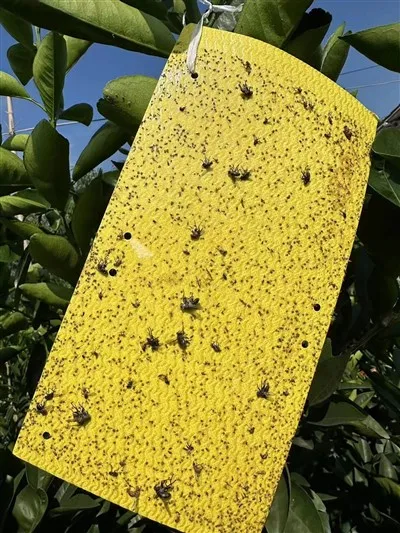
Physical and biological control: Make use of adult phototaxis; install solar frequency-vibration insect killing lamps to trap adults. During the early peak of moth emergence of key damaging generations, deploy sex-pheromone smart aerosol dispensers or pheromone traps in contiguous rice paddies. Before adult emergence, place 45 food-bait inverted-funnel traps per hectare. For biological control, release Trichogramma japonicum wasps at early moth-peak of key generations, 120000-150000 wasps per hectare each release. Egg parasitism rate by Trichogramma can exceed 80 %. Where feasible, adopt rice-duck co-culture: release 150-200 ducks per hectare at early tillering stage.

Chemical control: Adopt the strategy "suppress early generations to mitigate later damage; treat young larvae at early stage". Apply pesticides at the period from egg-hatching peak to young-larvae high-incidence stage. At tillering stage, take advantage of rice compensatory capacity to reduce pesticide applications. Rotate active ingredients including Tetrachlorantraniliprole, Indoxacarb, Spinosad, Emamectin benzoate and others. Alternate chemicals with different modes of action to delay resistance development. Apply strictly following recommended dosages, observe pre-harvest intervals, avoid arbitrary dosage increase and frequent spraying to guarantee rice product safety.
Data Sources
Technical Guidelines for Pest Prevention and Control, National Agro-Tech Extension and Service Center (NATESC)
NY/T 2737.1-2015 Technical Specification for Control of Rice Leaf Folder and Rice Planthopper-Part 1: Rice Leaf Folder
T/GDPPS 031-2025 Technical Code of Practice for Ecological and Light-Simplified Prevention and Control of Striped Stem Borer and Rice Leaf Folder