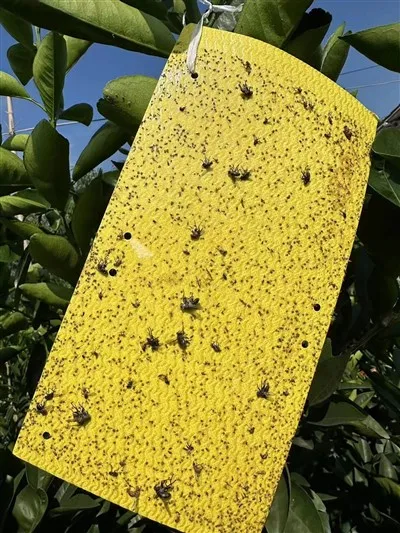
Rice pest control should follow the principles of "prevention first, integrated management, and green reduction", using pesticides scientifically and rationally, promoting pesticide reduction and control technologies, and focusing on controlling pests such asrice stem borer(Chilo suppressalis), rice leaf roller(Cnaphalocrocis medinalis), rice planthopper(Nilaparvata lugens), andgolden apple snail(Pomacea canaliculata).
Rice Stem Borer
The striped stem borer (Chilo suppressalis) is an insect of the order Lepidoptera, family Crambidae, and genus Chilo. Adults are yellowish-brown or grayish-brown, with females larger than males; the forewings are slightly rectangular, and the hindwings are white. The rice stem borer is an important pest of rice and other gramineous crops. Newly hatched larvae congregate within the leaf sheaths, causing sheath dieback. Larvae from the third instar onwards bore into the rice plant, causing dead hearts during the tillering stage, dead panicles during the booting stage, whiteheads during the heading stage, and damaged plants during maturity.

During the early stages of pest infestation, measures such as deploying insecticidal lamps and pheromone traps in seedling fields, as well as releasing Trichogramma spp. (egg parasitoids), can effectively lower the initial borer population and reduce the frequency of pesticide applications. After transplanting, the pesticide control targets are an 8-10% rate of dead sheath clusters or a 3% rate of dead sheath plants during the tillering stage. Use biological pesticides such as Metarhizium anisopliae and chlorantraniliprole, or low-toxicity, high-efficiency chemical pesticides.
Rice planthopper
Rice planthoppers are insects belonging to the family Delphacidae in the order Homoptera. They are small, resembling tiny cicadas; their mouthparts are needle-like; adults have two pairs of translucent wings; their heads are generally pointed, their antennae are short and stout with a bristle at the end; and their hind tibiae have a coarse spine on the inner side of the end. Adult and nymph rice planthoppers feed by sucking sap from the lower parts of rice plants. Their salivary glands secrete toxic substances that can block vascular tissues or cause rice plants to wither.

The focus should be on applying pesticides during the mid-to-late stages of rice growth, with control targets of 1000 insects per 100 rice plants during the booting stage and 1500 insects per 100 rice plants during the heading stage. Suitable pesticides include Metarhizium anisopliae CQMa421, Triflumezopyrim, Nitenpyram, Dinotefuran, Sulfoxaflor.
Rice leaf roller
The rice leaf roller (Cnaphalocrocis medinalis) is an arthropod of the order Lepidoptera, family Crambidae, and genus Cnaphalocrocis. The rice leaf roller is a major pest of rice in some parts of China. Its larvae spin silk to bind rice leaves together into a sheath, feeding on the upper epidermis and mesophyll tissue inside, causing white leaves, affecting photosynthesis, and leading to reduced rice yield.

Based on field pest monitoring, the control targets are 150 leaf tips per 100 clumps during the tillering stage and 60 leaf tips after the heading stage. From the late egg hatching stage to the 1st-2nd instar larval stage, use Bacillus thuringiensis, indoxacarb, etc. When spraying, make sure to thoroughly penetrate the leaves and allow the pesticide solution to seep into the leaf sheaths.
Golden apple snail
Golden apple snails are a typical invasive alien species.They are large, with shells that are mostly yellowish-brown or light brown, a large opening, a flat operculum, and an extremely high reproductive capacity. They mainly feed on seedlings of crops such as rice, severely impacting crop yields, damaging the farmland ecosystem, and causing great harm.

In addition to measures such as raising ducks in rice paddies to prey on snails and using physical barriers in irrigation ditches (interception nets + plastic traps), when the snail density in the rice seedling stage reaches 1-2 snails/square meter and during the tillering stage it reaches 3-4 snails/square meter, Niclosamide ethanolamine salt can be used.