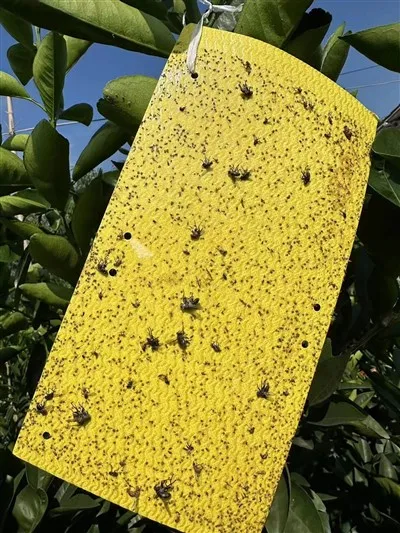
China is one of the world's origins of citrus fruits and is the world's largest citrus grower and second-largest producer. Citrus is one of the most widely cultivated and economically important fruit trees in China.Citrus cultivation and production are susceptible to damage from various pests.Common citrus pests include fruit flies(Tephritidae), moths, planthoppers(Delphacidae), aphids(Aphididae), beetles, and thrips(Thripidae). Physical control is one of the important control measures in green pest management. Among them, insect sticky traps are the most widely used physical control method, and they are very effective in controlling these pest. Currently, the insect sticky traps widely used in production are mainly yellow and blue traps. However, in application, there are problems such as inaccurate color and poor insect selectivity, which leads to the insect sticky traps having a greater impact on non-target insects.
This paper utilizes CMYK color mixing technology to prepare 18 different colored insect-attracting traps and systematically studies the attraction effect of these 18 different colored insect-attracting traps on insects in citrus orchards, laying the foundation for the sustainable control of pests in citrus orchards.
1 Materials and Methods
1.1 Test materials
This experiment selected 18 different colored insect sticky traps (Table 1), with a size of 25cm × 30cm. The traps were coated with glue on one side, and the glue layer was uniform. The standard "Plant Protection Machinery - Insect-Attracting traps (GB / T 24689.4-2009)" was followed. The colors of the insect-attracting traps were achieved using CMYK color mixing technology. The colors are shown in Table 1. All traps used in the experiment were supplied by Sichuan Ruijinte Technology Co., Ltd.
1.2 Experimental Design
The experiment was conducted in a citrus orchard in Honghua Village, Heilong Town, Qingshen County, Meishan City, Sichuan Province. Heilong Town is located at 103°50'E, 29°51'N, west of the Minjiang River, mainly an alluvial plain with some low hills to the north and west, at an altitude of 391~422 m. The citrus orchard site is flat and open, with large-scale contiguous planting (> 80hm²). The soil is yellow loam, and the orchard contains 3-year-old fruiting citrus trees of the 'Harumi' variety, with a height of 1.5~2 m and a planting density of 40 trees/667 m². The planting and management conditions of the citrus orchards are basically the same, and pest infestations have been severe in previous years. The experiment consisted of 18 treatments, each with 3 replicates, using a randomized block design. One insect sticky trap was hung on a citrus branch in each plot, which was 25 m² in size and hung at a height of 120 ± 10 cm from the ground. The traps were replaced after 7 days, and the removed traps were brought back to the laboratory to investigate the species and number of insects on them. This was repeated 3 times. Commonly used yellow traps (NO. 18) and blue traps (NO. 17) were used as controls.

1.3 Data processing
Statistical analysis was performed using DPS 6.0 data processing software, and the significance of differences was analyzed using Duncan's new multiple range test.
2 Results and Analysis
2.1
In the experiment using 18 types of insect traps in a citrus orchard, insects belonging to eight orders - Lepidoptera, Diptera, Hemiptera, Thysanoptera, Neuroptera, Hymenoptera, Coleoptera, and Isoptera - were collected. Table 2 presents the trapping results for insects of different orders.

As shown in Table 2, the insects primarily trapped by the sticky traps in the citrus orchard belonged to the orders Diptera and Thysanoptera.Trap No. 2 showed distinct selectivity for Diptera, capturing 1013 insects per trap; this figure was significantly higher than the 540.4 insects/trap captured by the yellowtrap (No. 18) and the 706.8 insects/trap captured by the blue trap (No. 17).Trap No. 12 demonstrated distinct selectivity for Thysanoptera, capturing 3222.3 insects per trap-significantly higher than the 236.6 insects/trap captured by the yellow trap (No. 18) and the 2659.5 insects/trap captured by the blue trap (No. 17).Trap No. 5 showed distinct selectivity for Lepidoptera, capturing 48 insects per trap; this was significantly higher than the 13.0 insects/trap captured by the yellow trap (No. 18) and the 6.25 insects/trap captured by the blue trap (No. 17).Trap No. 10 exhibited distinct selectivity for Hymenoptera, capturing significantly more insects than the yellow trap (No. 18), which captured 7.4 insects per trap. The 18 types of sticky traps showed poor trapping efficacy for insects belonging to the orders Hemiptera, Isoptera, Neuroptera, and Coleoptera.
2.2
After using 18 different colored insect-attracting traps to attract insects in the citrus orchard, a total of the following insects were attracted: Pieridae of Lepidoptera, Cecidomyiidae ,Tephritidae and Muscidae of Diptera, Cicadellidae of Hemiptera, Thripidae of Thysanoptera, Termitidae of Isoptera, and Chrysomelidae of Coleoptera, citrus orchard pests from 8 families. The effectiveness of 18insect-attracting sticky traps in attracting pests in citrus orchards is shown in table 3.

As shown in Table 3, trap No. 5 was the most effective for trapping Pieridae, with a catch of 47.0 insects/trap, showing a significant difference compared to the yellow trap (No. 18) and the blue trap (No. 17). Trap No. 2 was the most effective for Cecidomyiidae, with a catch of 895.8 insects/trap, showing a significant difference compared to the yellow and blue traps. Trap No. 7 was the most effective for Muscidae, with a catch of 18.0 insects/trap, showing a significant difference compared to the yellow and blue traps. Trap No. 12 demonstrated distinct selectivity for Thripidae, with a catch of 3222.3 insects/trap; this figure was higher than that of the yellow trap (236.6 insects/trap) and the blue trap (2,659.5 insects/trap), and the difference was significant. The blue trap (No. 17) was the most effective for Cicadellidae, with a catch of 7.3 insects/trap; the difference was not significant compared to the yellow trap but was significant compared to the other traps. None of the 18 types of traps were effective for Tephritidae, Termitidae, or Chrysomelidae.
2.3
After using 18 different colored insect-attracting traps to attract insects in the citrus orchard, it was found that the traps also attracted some natural enemies, mainly Syrphidae and Tachinidae of Diptera, Chrysopidae of Neuroptera, Ichneumonidae and Braconidae of Hymenoptera, and Coccinellidae of Coleoptera. Natural enemy insects from 6 families. The attraction of different families of natural enemy insects in citrus orchards by 18 insect-attracting traps is shown in Table 4.

As shown in Table 4, the traps that had a significant impact on natural enemies were trap No. 1, trap No. 7, trap No. 14, trap No. 15, and the yellow trap No. 18; each of these captured a total of more than 10.0 natural enemy insects per trap. Specifically, the yellow trap No. 18 had the greatest impact on natural enemies of the family Syrphidae, capturing 7.2 insects per trap.Traps No. 15, No. 1, and No. 7 primarily affected natural enemies of the family Tachinidae, with capture rates of 12.0, 8.0, and 7.5 insects per trap, respectively. Trap No. 10 had the most significant impact on natural enemies of the family Ichneumonidae, capturing 5.7 insects per trap. The 18 types of traps had minimal impact on natural enemies belonging to the families Chrysopidae, Braconidae, and Coccinellidae, capturing fewer than 1 insect per trap in each case.
3 Conclusions and Discussion
Different colored insect sticky traps can improve insect selectivity, reduce the impact on natural enemies, and minimize damage to biodiversity, showing broad application prospects. This experiment compared the effects of 18 different colored insect sticky traps on insects in citrus orchards with common yellow and blue traps. The comparison revealed the most effective insect trap colors. Based on the effects of each color on natural enemies, suitable application patterns for insect traps in citrus orchards were summarized: trap No. 12 was used for Thripidae; No. 5 for Pieridae; No. 2 for Cecidomyiidae; No. 7 for Muscidae; and blue trap No. 17 for Cicadellidae. This experiment can screen out colors with strong insect attraction to pests and safety to neutral insects and natural enemies, showing potential for widespread application in citrus cultivation systems. However, citrus pests are generally multi-pronged and require the use of multiple different colored traps for control. Further research is needed on how to rationally combine and use these traps.
Note: The above excerpt was published in Sichuan Agricultural Science and Technology.