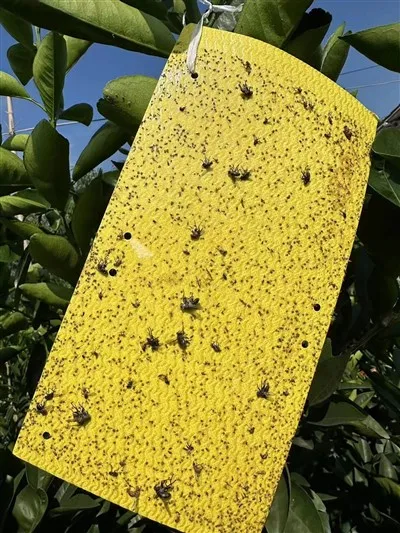
As an important tool for agricultural pest control, sticky insect traps play a key role in global agricultural production. With the deepening development of international trade, the classification and technical characteristics of sticky insect traps have become a focus of attention in the foreign trade industry. Understanding the functions and application scenarios of different sticky insect trap types can help companies accurately meet international market demand and enhance product competitiveness.
Based on their functional principles, sticky insect traps are primarily divided into two categories: physical traps and chemical traps. Physical traps attract pests by color, light, or shape. For example, yellow sticky traps exploit the insect's attraction to yellow and are widely used in greenhouses and open fields. These traps are generally chemical-free and meet environmental requirements, making them popular in strictly regulated markets such as the EU. Chemical traps attract specific pests by releasing pheromones or attractants, offering greater precision and suitability for large-scale farms. These products have a higher technical barrier to entry and are often exported to regions such as North America and Australia, where demand for effective pest control is high.
Based on their application, sticky insect traps can be divided into fixed and mobile types. Fixed traps, such as hanging sticky traps, are suitable for long-term monitoring and control and are commonly used in orchards and tea plantations. Mobile traps, such as handheld sticky traps, are easy to operate in the field and are suitable for small-scale growers. Foreign trade companies should select products tailored to the growing patterns of their target markets. For example, Southeast Asia prefers economical, simple traps, while the Middle East prioritizes durable, heat-resistant and weather-resistant models.
Currently, global demand for environmentally friendly and intelligent sticky traps continues to grow. Foreign trade practitioners should thoroughly research agricultural policies and technical standards in various countries and, based on the specific characteristics of sticky traps, optimize their export product mix to meet international customer demand for efficient, safe, and sustainable agricultural solutions.