The green scarab beetle(Anomala corpulenta) belongs to the family Scarabaeidae in the order Coleoptera. Its larvae are known as white grubs, the most destructive underground pests for peanuts, corn, fruit trees and seedlings in China. It produces one generation per year, with both adults and larvae causing severe dual damage. Severe infestations occur year-round in Huang-Huai-Hai Plain, Yangtze River Basin and Southwest China. It is a key target pest specified in Agricultural Industry Standard NY/T 2683-2015 Code of Practice for Control of Major Soil Pests in Farmland.
Quick Identification: Adults measure 15-18 mm long with distinctive copper-green metallic elytra and yellowish-brown wing margins. They display strong phototaxis and feign death when disturbed. Larvae (white grubs) are milky white, C-shaped with yellowish-brown heads, dwelling 5-20 cm underground to feed on crop roots.

Adults and larvae cause damage in two phases: From June to August, adult beetles gather at night to devour leaves of fruit trees, corn and saplings, leaving countless holes and notches; severely damaged leaves are reduced to bare veins. Larvae cause harm from April to May and August to October. They gnaw fibrous roots, peanut pods and sweet potato tubers. After the root system is damaged, the plants wither and die, and the underground fruits are filled with insect holes, completely losing their commercial value.
Field research published in Plant Protection records 5-40 white grubs per square meter in peanut fields, triggering 10%-30% yield loss in ordinary plots and over 80% loss or total crop failure in heavily infested land. Oil crop trials by the Chinese Academy of Agricultural Sciences show 1.29 grubs per square meter in corn fields, with seedling mortality exceeding 12% under high pest density. A pest survey conducted in June 2024 at the Lianjiang Shiling Forest Farm Agarwood Base revealed that high-density infestations of grubs around the roots of young fruit trees could directly lead to the death of entire 1-3 year old seedlings.

All control measures comply with NY/T 2683-2015 and the scarab control guidelines from the National Apple Pest Control Cooperation Network, following an integrated strategy: suppress adults, kill white grubs and regulate soil ecology.
Agricultural Ecological Regulation: Deep ploughing after autumn harvest exposes deep-buried grubs to freezing temperatures and natural predators. Avoid continuous cropping of peanuts or corn; implement rotation between grasses and vegetables. Only fully decomposed organic fertilizer can be applied to prevent egg-laying by adults. Regularly clear orchard weeds to eliminate feeding and shelter habitats for beetles. Adult insects shake tree branches at dusk, using their feigning death behavior to manually kill the fallen adults.

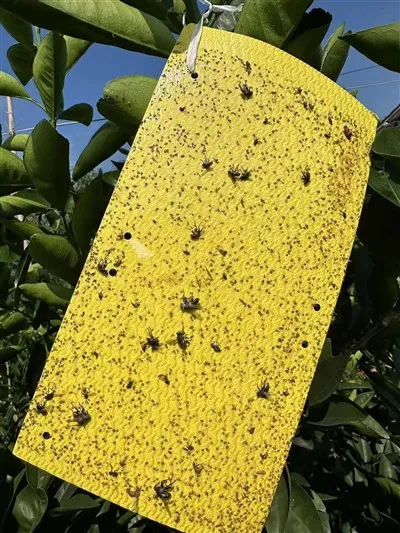
Physical and chemical methods to kill adult insects: Install frequency-vibration insecticidal lamps across contiguous farmlands and orchards (one lamp per 2-3 hectares), running from 19:30 to 22:00 to trap and kill adults. Use plastic traps combined with copper green scarab pheromone, along with green sticky boards, to continuously reduce the egg-laying population. For seedling nurseries, spread plastic film under trees at night to collect and eliminate shaken-off beetles.

Biological Soil Pest Control: Apply granular formulations of Metarhizium anisopliae and Bacillus thuringiensis HBF-1 into furrows before sowing, mixing them into soil during ploughing for long-term parasitism of white grubs. Interplant alfalfa or castor between crop rows during the growing season to repel scarab egg-laying. Skip chemical pesticides for lightly infested plots and rely on natural enemies to balance pest populations.
Soil Pesticide Control That Meets Standards: Carry out soil treatment once pest density reaches ≥2 grubs per square meter. Spread thiamethoxam or diazinon granules and plough into soil before sowing. Drench roots with low-toxicity abamectin or chlorpyrifos during crop growth. Rotate soil insecticides with different modes of action each year to delay grub resistance development. Strictly follow pre-harvest intervals for fruit and vegetable crops.
Data Source
Agricultural Industry Standard NY/T 2683-2015; field research data from Plant Protection journal; experimental statistics from the Oil Crops Research Institute, CAAS; 2024 field pest survey of Lianjiang agarwood base; national orchard scarab management technical guidelines.