Bemisia tabaci, commonly called whitefly, is a member of the Aleyrodidae family under Hemiptera. It is listed among the world's 100 worst invasive species and has been designated a key pest under the national technical control plan for oil and cash crops for years on end.
This pest breeds year-round in warm southern regions, while in northern China it survives winter mainly inside greenhouses. It features overlapping generations, ultra-fast reproduction, strong migratory capacity and severe pesticide resistance, making it one of the most destructive and hard-to-manage pests for greenhouse vegetables, melons, cotton and soybeans.
Quick Identification:Adults are tiny, around 1 mm long, pale yellow to white. At rest, they fold their two wings neatly in a roof shape. Nymphs attach firmly to leaf undersides, flat and oval, covered in thick white waxy powder with no ability to crawl freely. Clusters of tiny white specks on foliage are the most obvious field identification sign.

Whiteflies feed on over 600 agricultural and forest crops, with tomatoes, peppers, cucumbers, okra, cotton and soybeans as primary hosts. Damage falls into two categories: direct feeding and indirect virus transmission. Both adults and nymphs pierce leaves to suck sap, causing chlorosis, yellowing, wilting and stunted growth. They secrete heavy sticky honeydew coating leaves and fruits, triggering severe sooty mold and drastically cutting the market value of produce.

Its most devastating threat lies in virus transmission. It carries hundreds of plant viruses including tomato yellow leaf curl virus. Losses caused by viral outbreaks far outweigh direct feeding damage, and are a top cause of total crop failure in greenhouses.
Per the 2026 National Major Soybean Pest Occurrence Forecast issued by the National Agro-Tech Extension and Service Center, whiteflies are expected to infest 600,000 hectares of soybean fields nationwide in 2026, with severe outbreaks forecast for central Anhui and Henan in the Huang-Huai-Hai soybean belt, marking it a priority pest during soybean growth.
Field research from Fujian Academy of Agricultural Sciences records yield and quality losses exceeding 60% in heavily infested vegetable plots. Plant protection surveys from China Co-operation Times show widespread tomato yellow leaf curl virus transmitted by whiteflies leads to average yield losses of 50%-60%, with near-total harvest loss in severely infected fields.

Resistance monitoring data confirms whitefly populations along the Yangtze River have developed high-level resistance to thiamethoxam and spirotetramat, with resistance ratios peaking at 403-fold. Conventional pesticides deliver weak control effects, increasing pest management burdens year by year.
All control practices below comply with Technical Specification for Integrated Management of Bemisia tabaci in Protected Solanaceous Vegetables (DB61/T 1408-2021) and official green control guidelines from the National Agro-Tech Extension and Service Center, following the principles: prevention first, source isolation, early suppression and rational pesticide application.
1. Agricultural Source Control
Separate seedling nurseries from production zones to block cross-pest spread. Clear crop debris and weeds completely before transplanting to eliminate overwintering populations. Cover all vents and doorways of greenhouses with 40-mesh insect-proof netting to block incoming adult whiteflies. Regularly remove old, diseased and pest-covered lower leaves during the growing cycle; bury discarded foliage far from fields to reduce pest density.
2. Physical Trapping & Monitoring
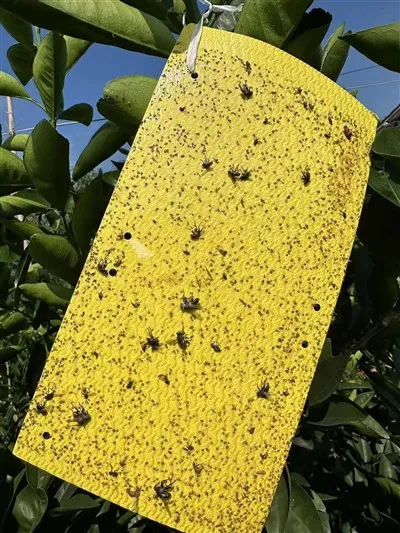
Hang 120–150 yellow sticky traps per hectare throughout the whole growing season, positioned 20 cm above crop canopies and evenly spaced across fields. Replace traps once fully covered with insects. This method simultaneously monitors pest population trends and traps migrating adults to suppress early infestations.

3. Ecological & Biological Control
At the early stage of infestation, release 30,000 Encarsia formosa wasps per hectares in two separate applications seven days apart, relying on parasitic natural enemies to curb whitefly numbers. For lightly infested plots, apply Metarhizium anisopliae biopesticides at dusk to avoid high temperature and strong sunlight that degrade active ingredients. This protects native beneficial insects and enables sustainable chemical-free pest suppression.

4. Threshold-Based Precision Chemical Control
Initiate pesticide treatment immediately once the official action threshold is hit: ≥1 adult whitefly on three leaves per 100 plants. Discontinue highly resisted chemicals thiamethoxam and spirotetramat in high-resistance regions; rotate low-risk, high-efficiency options such as afidopyropen and abamectin. Restrict each pesticide with the same mode of action to only one application per crop cycle to slow resistance buildup. Direct spray coverage toward leaf undersides for full penetration. Large contiguous farmlands should adopt professional unified pest control for consistent results.
Data Source Summary
2026 national soybean pest forecast from National Agro-Tech Extension and Service Center; field trial data from Fujian Academy of Agricultural Sciences; crop pest survey reports from China Co-operation Times; national pesticide resistance monitoring statistics for whitefly; local standard DB61/T 1408-2021; official national green prevention and control technical guidelines.