Customer Case Study | Ghana | Fruit Fly Monitoring & Control Solutions
Customer Background
In July 2022, Alfred Agbenyeke, a customer from Ghana, contacted our online store while searching for solutions to a fruit fly problem affecting mango growers in his market.
Alfred runs Brynfred Trading Enterprise, a small agricultural supply business dealing in products such as sprayers, fertilizers, and other farming supplies. Many of his customers are mango growers who were struggling with fruit fly infestations and looking for more reliable ways to protect their crops.
Although chemical pesticides could kill fruit flies quickly, his customers were still facing recurring infestations. Some pests escaped treatment, and the fruit fly population could increase again within a short period. Repeated pesticide applications also raised concerns about pesticide residues and whether harvested mangoes could meet processing factory requirements.
Alfred was looking for a practical solution that he could recommend to his mango-growing customers without relying entirely on repeated chemical spraying.
The Challenge: Recurring Fruit Fly Infestations in Mango Orchards
Fruit flies are a serious concern for mango growers because they can damage fruit and affect its marketability. For Alfred's customers, the problem was not simply killing the fruit flies they could see. It was managing an infestation that could return quickly after treatment.
The growers had already tried chemical pesticides, but the results were not always satisfactory. Some fruit flies survived treatment, while the pest population continued to develop and spread.
This created several concerns for Alfred and his customers:
Recurring infestations: Fruit flies could reappear soon after pesticide applications.
Limited control of surviving pests: Some fruit flies escaped treatment, making repeated applications necessary.
Pesticide residue concerns: Growers were worried that excessive pesticide use could create difficulties when mangoes were inspected by processing factory.
The need for a practical alternative: They wanted a solution that could help monitor pest activity and support more targeted control decisions.
Alfred knew that his customers needed something more than another pesticide recommendation. However, he was not familiar with fruit fly traps or pheromone-based monitoring products, so he began searching online for information.
Identifying the Fruit Fly Before Recommending a Solution
When Alfred found our online store, he noticed that we had information about fruit fly monitoring and trapping products. He contacted our sales team to ask whether we could help with the pest problem in his customers' mango orchards.
Before recommending any products, our sales representative explained that "fruit fly" is a common name used for different species. Trap selection and attractant compatibility depend on the target species, so identifying the insect was an important first step.
Alfred initially described the pest as Bactrocera invadens. We asked him to obtain several photographs of the insects so that we could better understand what his customers were dealing with.
He soon collected photos from his customers and sent them to our sales representative. Based on the images, we suspected that the pest was Bactrocera dorsalis, commonly known as the oriental fruit fly.
To improve the accuracy of the identification, we also shared the photographs with Wang Haijian, an associate professor in the Plant Protection Department at Sichuan Agricultural University. After carefully examining the images, Mr. Wang confirmed that the insect was Bactrocera dorsalis.
Our sales representative also reviewed relevant scientific literature and found research discussing the taxonomic relationship between Bactrocera dorsalis and Bactrocera invadens, including their treatment as names associated with the same species. (Yu Daojian, Zhang Weifeng, Lu Xiaoyu, et al. Classification Dynamics of Five Important Composite Species of Oriental Fruit Fly [J]. Plant Quarantine, 2015, 29(03): 9-15.)

This process helped us establish a more reliable basis for recommending a fruit fly control strategy rather than selecting products based only on a common pest name.
Our Solution: A Combined Fruit Fly Monitoring and Trapping Strategy
After confirming the target pest, we recommended an integrated approach using yellow sticky traps, methyl eugenol attractant, and reusable fruit fly traps.
Instead of relying on one product for every situation, we explained how each product could serve a different purpose depending on pest activity and the growers' monitoring needs.
1. Yellow Sticky Traps for Routine Pest Monitoring

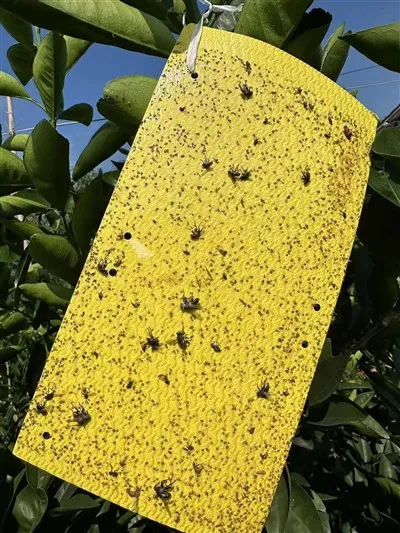
We recommended yellow sticky traps as a starting point for monitoring insect activity in the orchards.
Yellow sticky traps are easy to deploy and do not require complicated equipment. They can help growers observe changes in insect activity over time and identify whether pest pressure is increasing.
For Alfred's customers, yellow sticky traps offered a practical way to begin monitoring their orchards before committing to a more intensive trapping program.
Under suitable field conditions, our yellow sticky traps can remain in use for up to approximately three months, depending on dust, rain, insect accumulation, and other environmental factors.
We suggested that growers regularly inspect the traps and record the number of insects caught. If catches increased significantly, they could investigate the infestation and consider additional targeted control measures.
2. Methyl Eugenol for Targeted Oriental Fruit Fly Attraction

Once the target species was identified as Bactrocera dorsalis, we recommended methyl eugenol as a targeted attractant for attracting male oriental fruit flies.
Compared with general insect-monitoring tools, methyl eugenol offers species-targeted attraction for male B. dorsalis, making it a useful component of a more focused monitoring and trapping program.
We explained that the attractant has a shorter effective service period than yellow sticky traps. Although the product may remain effective for around three weeks under some conditions, Ghana's local environment could shorten its effective duration to approximately two weeks.
For this reason, we recommended inspecting the traps and considering replacement after around two weeks, depending on observed trapping performance and local conditions.
3. Reusable Fruit Fly Traps for a More Targeted Trapping Program

Fruit Fly Trap
We also recommended reusable fruit fly traps to be used together with methyl eugenol.
The attractant draws target male fruit flies toward the trap, while the trap provides a way to capture them. Since the traps can be reused, growers can retain the trapping equipment and replace the attractant as needed.
This combination offered Alfred's customers a more targeted trapping option when fruit fly activity increased, rather than relying only on routine monitoring.
How the Three Products Work Together
|
Product |
Main Purpose |
Recommended Use |
|
Yellow sticky traps |
General insect monitoring and trapping |
Routine orchard inspection |
|
Methyl eugenol |
Attracting male Bactrocera dorsalis |
Targeted fruit fly monitoring and trapping |
|
Reusable fruit fly traps |
Capturing attracted fruit flies |
Used with the Methyl eugenol |
Our recommendation was to begin with routine monitoring and adjust the trapping strategy according to observed pest activity.
Yellow sticky traps could help growers observe changes in insect activity, while methyl eugenol and fruit fly traps provided a more targeted approach for oriental fruit fly monitoring.
This gave Alfred a practical strategy to introduce to his customers without requiring them to purchase every product at the beginning.
Starting with Samples Before Placing a Bulk Order
Since Alfred had never imported this type of pest monitoring product before, he was understandably cautious about placing a large order without testing it.
After discussing the proposed solution, he decided to purchase a small quantity of yellow sticky trap samples first.
We helped him arrange international courier shipping for the sample order. Although courier shipping was relatively expensive, it was suitable for small shipments and offered a faster delivery option, allowing Alfred to receive the products and begin testing without waiting for a sea freight shipment.
Once the samples arrived in Ghana, Alfred distributed them to several mango-growing customers who were familiar with him. He also personally visited the growers to check how the traps performed in their orchards.
After testing, both Alfred and his customers were satisfied with the results and felt that the products met their expectations.
The successful sample trial gave him the confidence to move forward with his first formal order in September 2022.
Flexible Shipping Options for Samples and Bulk Orders
For Alfred, product performance was only one part of the purchasing decision. As a small agricultural supplier importing products into Ghana, shipping costs and delivery arrangements were also important.
We therefore discussed different logistics options based on his order size and purchasing stage.
For sample orders: International express courier was recommended. It offered faster delivery and was more practical for small shipments, although the shipping cost per unit was higher.
For larger orders: We planned a more economical shipping route involving sea freight to Tema Port, followed by local delivery to his company.
This arrangement gave Alfred two options: use express shipping when he needed products quickly for testing, and use sea freight when purchasing larger quantities to reduce transportation costs.

Having a shipping plan in place also made it easier for him to consider future orders as his customers became more familiar with the products.
From the First Trial to Long-Term Repeat Orders
The first formal order was placed in September 2022 after Alfred and his customers had tested the yellow sticky traps.
In January 2023, he returned to purchase methyl eugenol attractant and fruit fly traps, expanding his product selection beyond the initial sample order.
Since then, the cooperation has continued. Alfred typically places around four to five orders each year, mainly purchasing yellow sticky traps, methyl eugenol, and fruit fly traps.
Although the individual order values are relatively modest, the cooperation has remained consistent over the years.
During this period, Alfred has also purchased other pest control products, including thrips attractants. We have supported him with additional product recommendations and customized packaging materials to meet his business requirements.

His purchasing needs have gradually expanded from a single product trial to a broader range of agricultural pest monitoring solutions.
More Than a Product Supplier: Supporting a Growing Agricultural Business
This cooperation started with a simple question about fruit flies in mango orchards. However, the process involved much more than supplying traps.
We helped Alfred and his customers through several stages of the purchasing decision:
Pest identification: Reviewing insect photographs and seeking professional confirmation before recommending products.
Solution selection: Matching yellow sticky traps, methyl eugenol, and reusable fruit fly traps to different monitoring and trapping needs.
Sample testing: Helping the customer evaluate product performance before making a larger commitment.
Shipping arrangements: Providing different shipping options for small sample orders and larger shipments.
Product expansion: Supporting the purchase of additional pest monitoring products.
Packaging support: Providing customized packaging solutions as his purchasing needs developed.
For a small agricultural distributor, this type of support can make the process of introducing unfamiliar products into a local market more manageable.
Conclusion
Alfred's experience shows that solving an agricultural pest problem often requires more than recommending a single product.
The process began with identifying the fruit fly species, understanding the growers' concerns, and selecting an appropriate monitoring and trapping strategy. It continued with sample testing, logistics planning, and adjustments to the product range as the customer gained experience.
What began as an online inquiry in July 2022 developed into a recurring business relationship that continues to generate orders each year.
For agricultural distributors in Ghana and other African markets who are exploring fruit fly monitoring and trapping products, we believe a practical approach is to start by identifying the target pest, evaluating products on a small scale, and choosing a solution that fits local conditions and purchasing requirements.
Looking for fruit fly monitoring and trapping products for your agricultural customers?
We can help you evaluate suitable yellow sticky traps, attractants, and reusable trapping equipment based on your target pest, application environment, and order requirements.