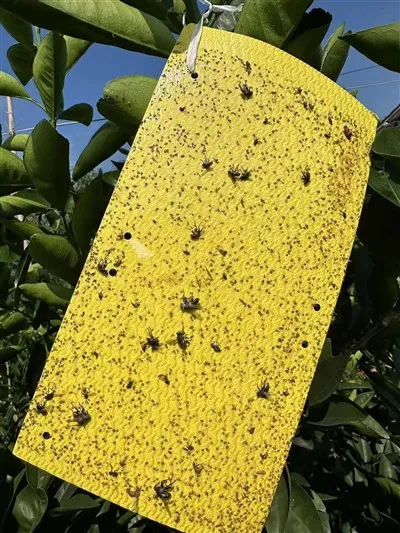
Phyllocnistis citrella, the citrus leafminer, belongs to the family Gracillariidae of the order Lepidoptera. It is one of the most destructive pests during the new shoot growth stage of citrus, distributed across all citrus-growing regions in China, with severe outbreaks in South China and citrus areas along the Yangtze River Basin.

Adults measure about 2 mm in body length and have a wingspan of roughly 5.3 mm. The body and wings are silvery white. Its forewings are pointed leaf-shaped, marked with two black longitudinal stripes at the base and a Y-shaped black marking in the middle. Hind wings are needle-like with extremely long fringe hairs. Eggs are oblate, 0.3-0.4 mm long, white and transparent. Larvae are flat, spindle-shaped and yellowish-green, with a pointed head and degenerated legs. A pair of slender tail filaments is present at the abdomen tip. Fully-grown larvae reach approximately 4 mm. Pupae are flat spindle-shaped, around 3 mm long, turning from pale yellow to dark brown, enclosed in a thin golden cocoon.

Larvae mine inside young leaves and tender shoots. They tunnel beneath the epidermis and feed on mesophyll tissue, creating silvery winding mines. Infested leaves curl, harden and shed prematurely. Weakened new shoots impair tree vigour and next year's flowering and fruiting. Wounds caused by larval feeding facilitate infection by citrus canker and mite pests. Rolled leaves serve as shelter and overwintering sites for spider mites, yellow mites and tortrix moths.
This pest produces more than 12 generations per year in southern regions and 8-9 generations in northern citrus zones, with overlapping generations. It mainly overwinters as pupae inside folded leaf margins of autumn and winter shoots. Optimal conditions for reproduction are 24-28 ℃ and about 80% relative humidity. Damage starts in early June with summer shoot emergence and continues until early October when autumn shoots mature. Peak infestation occurs from August to September. Nursery trees and young orchards suffer heavier damage because of irregular continuous flushing that favours adult oviposition and larval development.

Field surveys from Longzhou Plant Protection Station, Guangxi: autumn shoot damage rate generally ranges from 5.2%-18.5%, exceeding 30% in heavily infested orchards. Each shoot normally hosts 1-2 larvae, while severely damaged shoots carry 5-7 larvae. Surveys in Huazhou, Guangdong show an average of 30 larvae per 100 shoots, with a maximum of 375. The average shoot/leaf damage rate is 13%, up to 80% in severe cases. Studies published in Plant Doctor journal indicate that less than 20% leaf injury on autumn shoots has little impact on citrus growth and fruit weight in the following year. The economic threshold is set at 0.74 larvae per young leaf. Yield loss can exceed 50% in high-incidence zones, and around 10% in moderate outbreak areas.
Integrated Pest Management (referenced to DB42/T 1668-2021 Technical Specification for Forecasting and Control of Citrus Leafminer)
Regulate fertilisation and irrigation during summer and autumn shoot development. Remove and burn scattered, uneven young shoots to synchronise flush growth and reduce pest populations. When new buds reach 1-2 cm, pluck off sporadic summer or autumn shoots every 5 days repeatedly. This promotes uniform shoot release at times with low pest pressure. Carry out winter pruning to cut out infested branches and reduce overwintering pupae.
Release parasitoid wasps such as Citrostichus phyllocnistoides during new shoot emergence for biological suppression. Foliar sprays of Bacillus thuringiensis are also applicable.
Spray for the first time when abundant new shoots emerge and young leaves are 0.5-3.0 cm long, with a damage threshold of 10%-20% injured young leaves. Repeat sprays every 7-10 days for 2-3 applications. Available pesticides include 10% imidacloprid wettable powder, 1.8% abamectin emulsifiable concentrate, 25% diflubenzuron wettable powder, chlorantraniliprole and tetraniliprole. Apply strictly following recommended dosages and pre-harvest intervals. Rotate pesticides with different modes of action to delay resistance. Don't arbitrarily increase dosage or spray frequency to guarantee fruit safety.
Data Source:
Longzhou County Plant Protection and Plant Quarantine Station, Guangxi
Huazhou Municipal Agriculture and Rural Affairs Bureau, Guangdong
Plant Doctor
DB42/T 1668-2021 Technical Specification for Forecast and Control of Citrus Leafminer (Phyllocnistis citrella)