The cotton bollworm (Helicoverpa armigera) belongs to Noctuidae of Lepidoptera. It is a globally important agricultural borer pest, widely distributed across all crop production regions in China. It is listed as a core target for prevention and control in the agricultural industry standard NY/T 4779-2025 Technical Code of Practice for Whole-process Integrated Management of Major Cotton Pests and Diseases. This pest features polyphagy, strong reproductive capacity and severe generation overlapping. It develops 3 to 7 generations annually, with more generations from northern to southern China. Adults have strong migratory ability and can spread across regions to cause damage. Once larvae reach the 3rd instar, they bore into buds, flowers, bolls and ears of crops. Their cryptic living habit leaves a short window for control, making them a major threat to stable yields of cotton, maize, soybean and other crops.

Adults are 15-20 mm long, mostly yellowish-brown or greyish-brown. Their forewings bear distinct ring-shaped markings and kidney-shaped markings, with seven small black dots along the outer margin. Mature larvae measure 30-40 mm, with variable body colours including green, brown and red. Obvious dorsal lines and subdorsal lines run along the back, and the body surface is covered with tiny spines.Typical damage symptoms: When infesting cotton, larvae mainly bore into cotton buds, flowers and bolls. Damaged buds turn yellow and shed within 2 to 3 days as bracts spread open. Damaged flower stigmas and anthers fail to pollinate and form bolls. Holes bored in green bolls often trigger secondary fungal infection and boll rot. Larvae also feed on cotton shoot tips and leaves, creating holes and notches, resulting in "headless cotton" and disrupting normal cotton growth.

The cotton bollworm infests dozens of crops including cotton, maize, soybean, peanut, tomato, pepper and sunflower, among which cotton and maize suffer the heaviest losses. Yield losses caused by boring damage are far higher than those from leaf feeding. According to the 2026 National Forecast on Occurrence Trends of Major Maize Pests and Diseases released by the National Agro-Tech Extension and Service Center, cotton bollworm is expected to infest 8 million hectares of maize fields nationwide in 2026. Severe outbreaks are projected in the Huanghuaihai region and southern Northeast China, posing a big threat to maize yield in the middle and late growth stages.Field surveys in Jingbian County, Shaanxi Province in 2026 showed widespread cotton bollworm occurrence across local towns and villages. The average infested field rate reached 30%, damaged plant rate 5%, with 3 larvae per 100 plants. The cotton bollworm prefers moderate temperature and high humidity; the optimal temperature range for development of all life stages is 25-28 °C. Favorable environmental conditions facilitate pest population build-up and aggravate damage.
Integrated Pest Management (in compliance with NY/T 4779-2025)
Agricultural and ecological regulation: Deep ploughing after crop harvest destroys overwintering pupal chambers and cuts overwintering pest populations. Rotate cotton with maize, soybean and vegetables to avoid continuous cropping that worsens pest pressure. Maintain rational planting density and scientific water and fertilizer management; avoid excessive nitrogen fertilization which leads to delayed crop maturity.
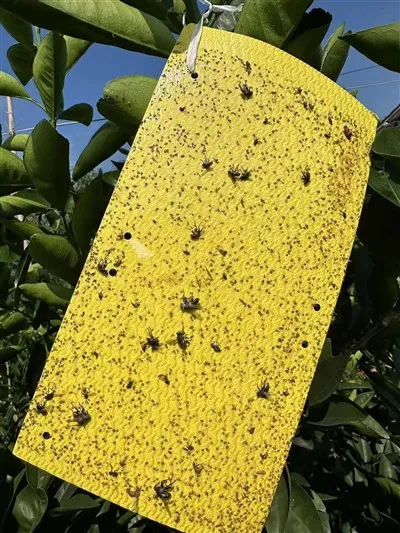
Physical trapping and pest monitoring: In contiguous crop fields, install one frequency vibration insecticidal lamp per 2-3 hectares to trap and kill adults at night. Deploy cotton bollworm pheromone traps at a rate of 15-30 traps per hectare to disrupt adult mating and oviposition. Monitor pest populations based on trap catches to accurately predict the optimal control window.
Biological green prevention and control: Release Trichogramma chilonis artificially during the peak oviposition period of adults, at a rate of 150,000 wasps per hectare each time, 2-3 releases per generation at intervals of 3-5 days. In the young larval stage, prioritize biological agents such as Helicoverpa armigera nucleopolyhedrovirus, Bacillus thuringiensis and Brevibacillus brevis. (Bt formulations are prohibited in Bt transgenic cotton fields). Apply pesticides in the evening to improve efficacy and conserve natural enemies in fields.

Targeted precision chemical control: In accordance with the 2021 notice issued by the National Agro-Tech Extension and Service Center on technical schemes for prevention and control of major crop pests and diseases including rice, chemical control shall be launched immediately when there are more than 10 young larvae per 100 plants in Bt transgenic cotton, or over 100 eggs accumulated per 100 plants in non-Bt cotton. Cotton yield usually drops by 10%-20% in moderate outbreak years, and over 30% in heavy outbreak years. Yield loss can exceed 50% in severely infested fields. Apply pesticides during the critical window from peak egg hatching to before larvae reach the 3rd instar. Target sprays on cotton buds and bolls for cotton, and maize ears and leaf whorls for maize. Select pesticides with different modes of action such as lufenuron, flufenoxuron, indoxacarb and spinosad, and rotate products to delay pesticide resistance. Strictly observe pesticide pre-harvest intervals. Implement unified pest control in contiguous fields to boost overall control effects.
Data Source:
Technical code of practice for integrated pest management during whole process of cotton production
Jingbian County Agriculture and Rural Bureau, Shaanxi Province
National Agro-tech Extension and Service Center (NATESC), 2026 National Occurrence Trend Forecast of Major Maize Pests and Diseases
NATESC, Notice on the Issuance of Technical Plans for the Prevention and Control of Major Pests and Diseases of Rice and Other Crops