Introduction
Citrus greening disease, also known as Huanglongbing, is one of the most destructive diseases in global citrus production. There is no cure for infected trees. Once a tree becomes infected, fruit quality and yield decline, and the tree eventually dies. The disease is spread by the Asian citrus psyllid , a small sap-sucking insect that can transmit the pathogen while feeding.
Because direct treatment options are limited, early detection of the psyllid vector is the most effective way to slow disease spread. This makes monitoring tools critically important for citrus growers, especially in regions where HLB is present or threatening to expand.
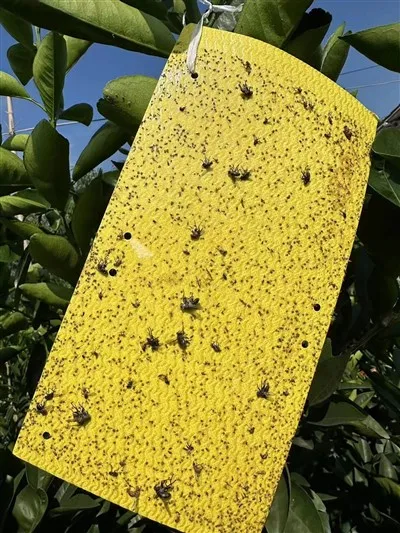
For many growers, yellow sticky traps are the default monitoring method. They are cheap, easy to hang, and require no power. But yellow sticky traps alone have a significant weakness: they attract and capture many different flying insects, not just citrus psyllids. This makes accurate counting difficult and increases the time required for field inspection.
Combining a species-specific pheromone lure with a yellow sticky board changes this picture. The pheromone attracts target psyllids, while the yellow color and sticky surface capture them. The result is a more targeted monitoring tool that generates cleaner data for pest management decisions.


How the Pheromone + Sticky Board System Works
Insect pheromones are chemical signals produced by insects to communicate with others of the same species. In many pest species, female insects release sex pheromones to attract males for mating. Synthetic versions of these pheromones can be used to lure male insects into traps.
In a pheromone + sticky board system, the pheromone lure is attached to or placed near a sticky board. The yellow color provides general visual attraction for flying insects, while the pheromone adds species-specific chemical attraction. When target insects approach the trap, they become stuck on the adhesive surface.
The sticky board serves two functions:
- It captures insects so they can be identified and counted.
- It keeps the pheromone lure in a fixed position, creating a stable monitoring station.
Because the pheromone lure is selective, the proportion of target insects on the trap increases. This makes counting faster and more accurate, especially for small insects like citrus psyllids that can be difficult to distinguish from other similar-looking species.
Why Standard Yellow Traps Fall Short for Citrus Psyllid
Yellow sticky traps are highly effective at catching a wide range of insects, including whiteflies, aphids, leafminers, and various flies. But in a citrus orchard, this broad attraction becomes a problem. A single yellow trap can be covered with dozens of non-target insects within days. Sorting through this catch to find a few small psyllids is time-consuming and prone to error.
In addition, citrus psyllids are small and may be overlooked when mixed with larger or more abundant insects. Technicians who check traps under time pressure may miss early psyllid arrivals, delaying response actions.
Pheromone lures do not completely eliminate non-target catches, but they significantly improve the target-to-non-target ratio. This is especially valuable for HLB monitoring programs where early detection is the highest priority.
Practical Deployment in Citrus Orchards
Field experience and standard practice suggest several key points for deploying pheromone sticky boards in citrus orchards:
- Placement density: Use enough traps to cover orchard blocks, with particular attention to borders and windward sides where psyllids may enter. A common approach is to place traps every 50 to 100 meters along orchard edges and at intervals within larger blocks.
- Hanging height: Hang traps at mid-canopy height, typically 1 to 1.5 meters above the ground. Traps should be visible and accessible for inspection without being hidden by dense foliage.
- Replacement interval: Sticky boards and pheromone lures should be replaced according to local pest pressure and weather conditions. In hot, dusty, or rainy periods, adhesive effectiveness may decline faster. Regular replacement ensures consistent monitoring data.
- Rainy and high-humidity conditions: In regions with frequent rain, waterproof sticky boards are strongly recommended. Standard paper-based boards can warp, tear, or lose adhesive when wet. Waterproof substrates maintain physical integrity and remain readable longer.
Pairing Sticky Traps with Other Monitoring Tools
Pheromone sticky boards can be used alone, but they often work best as part of a broader monitoring system. For example:
- Use sticky boards for weekly visual counts and species confirmation.
- Use automated traps or AI pest monitoring systems for continuous remote monitoring.
- Combine sticky board data with weather information to predict psyllid flight activity and disease transmission risk.
This layered approach provides both the simplicity of visual traps and the detail of digital monitoring. In orchards where HLB pressure is high, redundant monitoring methods reduce the risk of missed detections.
Common Misconception: Sticky Boards Are Not for Mass Trapping
A common misunderstanding is that sticky boards should be used to kill as many insects as possible. In practice, their primary role in citrus psyllid management is monitoring, not mass trapping.
Sticky boards alone cannot eliminate a psyllid population. Their value comes from detecting the presence and relative abundance of psyllids early enough to trigger a coordinated response. That response may include targeted insecticide applications, biological control releases, or area-wide management actions.
Attempting to use sticky boards for mass trapping often leads to saturated traps, high labor costs, and unreliable data. It is more effective to use them as decision-support tools within an integrated pest management framework.
Conclusion
For citrus growers facing HLB pressure, early detection of the Asian citrus psyllid is essential. A pheromone + sticky board system offers a practical, low-cost way to improve monitoring specificity and reduce the labor burden of trap inspection.
By understanding how pheromones and color attraction work together, growers can deploy traps more effectively and make better pest management decisions. The goal is not to catch every psyllid, but to know when and where psyllid pressure is increasing-before the disease spreads further.