Introduction
Sticky traps are among the most common physical monitoring tools used in greenhouses, nurseries, and open-field crop production. They are inexpensive, require no electricity, and provide a direct visual record of flying pest activity. However, choosing the right sticky trap is not as simple as hanging any yellow board.
Different pests, crops, and environments require different trap types. A trap that works well in a dry orchard may fail quickly in a humid greenhouse. A small trap that is easy to inspect in a nursery may become saturated too quickly in a high-pressure field. Understanding these differences helps growers collect reliable monitoring data while reducing labor and replacement costs.
This guide explains how to choose sticky traps based on target pest, growing environment, and operational needs.


Match the Trap to the Target Pest
Sticky traps are used to monitor a wide range of small flying pests. The most common targets include:
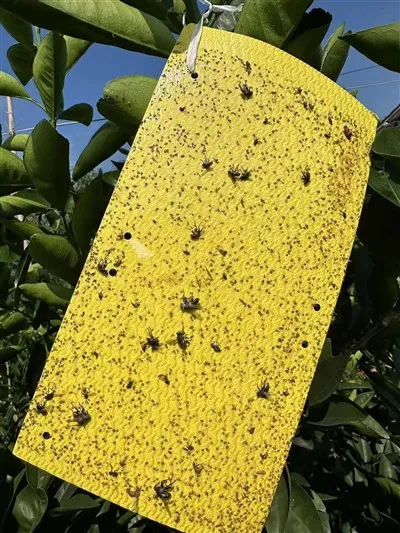
- Whiteflies and aphids Strongly attracted to yellow. Yellow sticky traps are the standard tool for early detection in vegetable and ornamental crops.
- Thrips Often attracted to blue as well as yellow. Blue sticky traps are sometimes used where thrips are the dominant pest, though yellow remains more common for general monitoring.
- Fungus gnats and shore flies Common in greenhouse and nursery production. Yellow sticky traps placed near growing media or benches provide early warning.
- Leafminers and small moths Yellow traps can capture adults, but species-specific pheromone lures are often added to improve selectivity.
- Fruit flies and other small flies Yellow sticky boards and smaller sticky traps can be used, sometimes with food-based or pheromone lures.
For general pest monitoring, yellow is the most versatile color. For thrips-specific monitoring in high-value crops, blue traps may provide better capture. However, blue traps can be more difficult to inspect because small dark insects are harder to see against the blue surface.
Consider the Growing Environment
Environmental conditions have a major impact on trap performance and durability.
- High-humidity greenhouses:In propagation houses, hydroponic facilities, and tropical greenhouses, condensation and irrigation create continuously high humidity. Standard paper-based sticky boards can absorb moisture, warp, or lose adhesive strength. Waterproof sticky cards with plastic or coated bases are the better choice. They maintain their shape and stickiness even when exposed to moisture.
- Open-field orchards and vegetable fields:Outdoor traps face UV radiation, wind, dust, and rain. Materials should be UV-stabilized to prevent fading and brittleness. Waterproof sticky cards are also beneficial in regions with regular rainfall. Traps placed near dusty roads or in windy areas may require more frequent replacement.
- Nurseries and small-scale production:In confined spaces with lower pest pressure, smaller traps are often sufficient. They are easier to hang among dense seedling trays and less visually intrusive. Double-sided sticky boards can be useful when space is limited, as they provide capture surface on both sides without requiring more hanging points.

Choose the Right Size
Sticky trap size should match pest pressure and inspection frequency.
- Low to moderate pest pressure: Smaller boards are easier to handle and count. They are suitable for early detection in clean production areas.
- High pest pressure: Larger boards capture more insects and take longer to become fully covered. This reduces the need for frequent replacement and provides more stable population estimates.
- Perimeter monitoring: Larger traps placed along field borders or entry points are easier to spot and provide a clearer signal of pest movement into the crop.
Using a trap that is too small for the pest pressure leads to rapid saturation, making counting difficult and data unreliable. Using a trap that is too large may be unnecessary in low-pressure areas and increases material cost.
Single-sided vs. Double-sided Boards
Single-sided sticky boards have adhesive on one side only. They are typically hung flat or attached to stakes. Double-sided boards have adhesive on both sides, increasing the total capture area.
Double-sided boards are especially useful:
- In greenhouses where insects may approach from any direction.
- In high-density crop canopies where air movement is limited.
- When hanging space is limited and maximum capture area is needed per trap.
The main disadvantage of double-sided boards is handling difficulty. Both sides are sticky, so they must be handled carefully during installation and removal. Some growers prefer single-sided boards for ease of inspection.
When to Add Pheromone Lures
Color attraction alone is broad and non-specific. For many monitoring programs, this is acceptable. But when the goal is to track a specific pest species-such as citrus psyllid, codling moth, or certain leafrollers-adding a pheromone lure makes the trap much more selective.
Pheromone lures attract male insects of the target species. The sticky board then captures them for counting. This combination is widely used in:
- Citrus psyllid monitoring for HLB prevention.
- Orchard moth monitoring for precise spray timing.
- Quarantine pest detection in export-oriented production areas.
When pheromone lures are used, the sticky board's main job is capture and retention, not attraction. The lure provides the species-specific signal that color alone cannot.
Practical Placement and Replacement Tips
Proper placement is just as important as trap selection. In greenhouses, hang traps just above the crop canopy and adjust height as plants grow. In open fields, place traps at crop height or slightly above, with extra traps along field edges and windward sides.
Replacement frequency depends on:
- Pest pressure and dust accumulation.
- Rain and humidity exposure.
- UV degradation of the board material.
- Loss of stickiness due to high insect capture.
In many production systems, sticky traps are replaced every one to four weeks. High-pressure environments may require weekly replacement. Waterproof and UV-stabilized traps often last longer than standard boards.
Green Pest Control and the Role of Sticky Traps
Sticky traps are a foundational tool in green pest control programs. They provide continuous, low-cost monitoring without chemical inputs. This is particularly important for organic farms, export vegetable bases, and IPM programs that aim to reduce pesticide use.
However, sticky traps are not a stand-alone pest control method. They are most effective when combined with other practices such as biological control, cultural management, and targeted pesticide applications when necessary. The data from sticky traps helps growers decide when and where action is needed, avoiding unnecessary treatments.
Conclusion
Choosing the right sticky trap requires attention to target pest, environment, trap size, and whether pheromone lures are needed. In humid greenhouses, waterproof sticky cards prevent early failure. In open fields, UV-stabilized and weather-resistant materials extend trap life. Double-sided boards offer extra capture area in confined spaces, while larger traps handle higher pest pressure.
By matching the trap to the situation, growers can build a more reliable and cost-effective pest monitoring program.