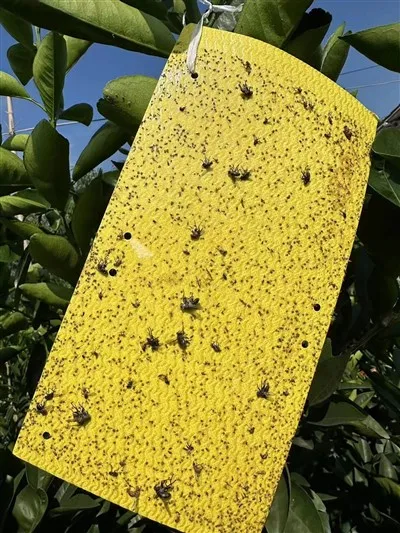
The oriental fruit moth (Grapholita molesta) belongs to Tortricidae of Lepidoptera. As a global fruit-boring pest, it is widely distributed in fruit-growing regions across northern and southern China. It mainly damages peach and pear trees, and also infests apricot, plum, cherry and various other fruit trees.
Adults are 5-7 mm long with a wingspan of 11-14 mm. The whole body is gray-brown. Around 10 groups of short white oblique stripes lie along the forewing leading edge, with scattered gray-white scales across the wing surface, and a distinct black spot near the apex on the hind margin. Eggs are flat-oval with a raised centre, milky-white and translucent; the larval head can be seen inside just before hatching. Mature larvae reach 10-13 mm, with yellow-brown head and anal plate. Pupae measure 6-7 mm, yellow-brown, with two rows of short spines on the dorsal abdomen. Larvae bore into young shoots and fruits. Strong boring capacity, concealed habit, multiple annual generations and severe generation overlap make this pest difficult to manage.

Damage Characteristics
Damage to new shoots: Larvae in spring and summer mainly bore into tender shoots. Gum exudation and frass appear at the penetration hole first. Then shoot tips wilt, droop and finally dry and break off, commonly called "shoot die-back". Larvae tunnel into the pith from leaf axils of the top 2-3 young leaves, feeding downward through 2-3 internodes. One larva can damage 3-4 shoots by moving between shoots. Heavy infestation causes widespread shoot loss.

Damage to fruits: Larvae in summer and autumn mainly feed inside fruits. They usually enter through calyx cavities, stem cavities, or contact surfaces between fruits, or between leaves and fruits. Bore holes are tiny and inconspicuous with slight surrounding depression. Early-stage infested fruits show fine frass around holes, which easily turn black. Late-stage infested fruits seldom show external frass. Larvae feed around the fruit core and fill the cavity with frass, forming a "bean-paste filling" condition that renders fruits completely unmarketable. Damaged fruits tend to drop. On pears, bore holes often turn black and rot outward, known locally as "black plaster".

Oriental fruit moth causes severe losses in Chinese orchards. Without proper control, fruit infestation rates commonly reach 30%-40% (Pingyuan County, Shandong Province). In heavily affected orchards, rates can hit 60%-80% or even above 90% (Chinese Academy of Agricultural Sciences). Susceptibility varies sharply among cultivars; late-maturing varieties suffer far higher damage than early-maturing ones. When green control techniques such as mating disruption are applied, fruit damage can drop from 22.80% to 8.33%, or even 0.06% (Daxing Pear Orchard, Beijing), demonstrating remarkable control performance.
Integrated Control Technologies (referring to NY/T 2685-2015)
Agricultural control: Avoid mixed planting of peach, pear, apple and other host species in new orchards to reduce cross-host transfer. During the growing season, promptly prune off infested shoots, remove wormy fruits, and collect fallen mummified fruits. Bury or destroy these materials to eliminate internal larvae. Before overwintering, scrape off loose old bark thoroughly, clean bark crevices and pruning wounds where pests overwinter, and clear orchard litter and weeds by deep burial or burning to cut overwintering populations. Rational pruning improves canopy ventilation and light penetration.
Physical and biological control: Install insect-killing lamps 30 cm above tree canopies to trap adults by phototaxis. Hang sugar-vinegar liquid traps to take advantage of adult chemotaxis. Mating disruption is a core green measure for oriental fruit moth control. Disperse disruption dispensers starting at full bloom, 600 pieces per hectare. Fasten 1-2 dispensers per tree at branch crotches in the middle canopy. The dispensers release sex pheromone steadily for more than 100 days to disrupt adult mating. For biological control, release Trichogramma wasps and apply Bacillus thuringiensis formulations.

Chemical control: Once larvae bore into shoots or fruits, chemical treatment becomes ineffective. Monitor pest pressure with sex pheromone traps. Apply insecticides at critical timings: 5-7 days after peak adult flights of the 1st and 2nd generations, and at the early peak of the 3rd-generation adults. Rotate active ingredients including lambda-cyhalothrin, fenvalerate, abamectin and chlorantraniliprole. Spray twice per generation at an interval of about 7 days. Follow label rates and pre-harvest intervals strictly. Alternate chemicals with different modes of action to delay resistance development. Do not arbitrarily increase dosage or spray frequency so as to guarantee fruit safety.
Data sources: Pingyuan County Shandong field survey, Chinese Academy of Agricultural Sciences, Daxing Beijing orchard trial data, Agricultural Industry Standard NY/T 2685-2015.