Conogethes punctiferalis belongs to Crambidae of Lepidoptera, commonly known as fruit-borer worm. It is a worldwide pest, distributed in Northeast, North, East, Central, South and Southwest China. Severe infestations mainly occur in peach-producing areas of Hebei and regions south of the Yangtze River Basin. It has a wide host range, infesting fruit trees including peach, plum, apricot, hawthorn, pear, apple, pomegranate, chestnut and pecan, as well as field crops such as sunflower, corn, sorghum and soybean.
The adult is 9-14 mm in body length with a wingspan of 22-25 mm. Its body is orange-yellow, covered with scattered black leopard-like spots on body and wings. There are 25-28 black spots on forewings and 10-15 on hindwings. The oval egg measures 0.6 mm long and 0.4 mm wide. It is milky-white at oviposition and gradually turns orange-yellow to reddish-brown. The fully-grown larva reaches 22 mm. Its body colour varies from light brown, pale grey to dark red, with dark-brown head and distinct black tubercles on each body segment. The pupa is about 13 mm long, changing from pale yellow-green to brown. It has slender anal spines with six curved hooks at the tip.
Larvae are the main damaging stage. They bore into fruits and feed on pulp. Reddish-brown frass piles and yellowish-brown transparent gum exudates appear on the surface of infested fruits, while the fruit interior is filled with frass and inedible. Damaged fruits often discolour, split or drop, greatly reducing yield and fruit quality.

In northern China, this pest completes 2-3 generations per year; 3-4 generations in Huang-Huai region and 4-5 generations in the Yangtze River Basin. Mature larvae overwinter inside cocoons in bark crevices, tree hollows, soil cracks, corn stalks, sunflower discs and mummified fruits. Overwintered pupation takes place in mid-to-late April, and overwintering adults emerge from late April to mid-May. First-generation larvae mainly attack early-ripening fruits of peach, plum and apricot. Second-generation larvae damage mid- and late-ripening peaches, and some shift to corn and sunflower. Third and subsequent generations primarily infest corn, sunflower and chestnut. Adults are nocturnal, strongly attracted to black light and sugar-vinegar mixtures. Outbreaks are aggravated under rainy and humid weather. Orchards with mixed or adjacent peach and pear trees suffer heavier damage.

Conogethes punctiferalis causes heavy losses across diverse hosts. In peach orchards, damaged-fruit rate can reach 60%-80%. Pomegranate orchards normally show 70% infested fruits, up to 90% in severe years. Chestnut producing areas generally record 30% fruit damage, exceeding 50% in high-infestation zones. Some pecan orchards in Anhui report 30%-80% damage rates. Fruit infestation rates of Prunus japonica in Pujiang and oil-tea in Lishui, Zhejiang are around 30% and 31.27% respectively. Susceptible macadamia varieties show 15.6%-21.8% damaged fruits.
Integrated Control Techniques (referring to T/SDAS 120-2020)
Cultural Control: Avoid mixed planting of multiple fruit species, especially peach and pear, when establishing new orchards. During growing seasons, remove damaged shoots and infested fruits, collect fallen and mummified fruits for deep burial or destruction to eliminate internal larvae. Before overwintering, thoroughly clear corn, sunflower and other host residues around orchards; scrape and destroy loose old bark to cut down overwintering populations. Tie grass bands on trunks before harvest to trap overwintering larvae for later elimination.
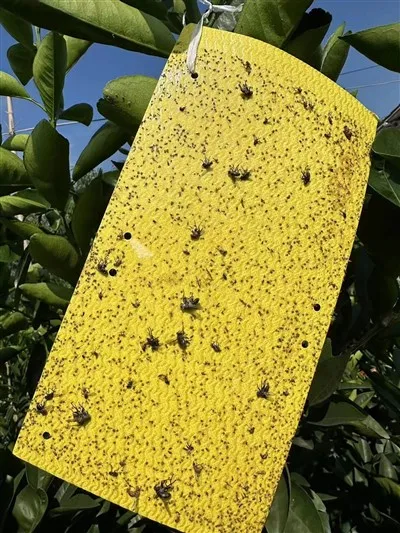
Physical and Biological Control: Make use of adult phototaxis. Install solar powered insecticidal lamps or black-light traps, one lamp per 2 ha, positioned 30 cm above tree canopy. Apply sugar-vinegar liquid traps to take advantage of adult chemotaxis. Deploy 45-75 pheromone traps per hectare for male adult mass trapping. Conduct fruit bagging roughly 20 days after fruit-set. Spray fungicide-insecticide mixtures prior to bagging to block oviposition. Raise poultry such as chickens, ducks and geese in orchards to prey on dropped larvae.

Chemical Control: Once larvae bore into fruits, chemical control becomes difficult. Monitor pest populations via pheromone traps and spray 5-7 days after adult peak flight. Rotate registered insecticides including lambda-cyhalothrin EC, 20% fenvalerate EC and 1.8% abamectin EC. Follow recommended dosages and pre-harvest intervals. Alternate chemicals with different modes of action to delay pesticide resistance.
Data sources: CNKI, Hebei Forestry and Grassland Bureau, Popular Science China, Anhui Forestry Bureau, Guangxi Academy of Agricultural Sciences, T/SDAS 120-2020