The melon fly (Bactrocera cucurbitae), also known as sting fly or melon maggot, belongs to the Tephritidae family under Diptera. It is a major destructive pest of cucurbit crops across southern China. Originating in India, this pest has spread to more than 30 temperate, subtropical and tropical countries. Within China, heavy infestations are found in Fujian, Hainan, Guangdong, Guangxi, Guizhou, Yunnan, Sichuan, Hunan and Taiwan.The melon fly spreads through the transport of eggs and larvae with its host, and adults also possess a certain degree of aerial dispersal ability.
Quick identification: The adult resembles a small wasp, yellowish-brown to reddish-brown, 7-9 mm long and 3-4 mm wide. The prothorax has yellow longitudinal stripes on the left and right sides and the mesothorax and metathorax. The wings are membranous and transparent with dark brown markings. The abdomen has black stripes, and the anterior margin of the third abdominal segment has a narrow, elongated black transverse stripe, forming a distinct "T" shape with the central longitudinal stripe. The ovipositor is flat and hard. The eggs are slender, 0.8-1.3 mm long, and milky white; the mature larva is maggot-like, about 10 mm long, and milky white; the pupa is initially yellowish-white, later turning yellowish-brown, cylindrical, and about 5 mm long.

This insect primarily damages cucurbitaceous plants, with hosts including cucumbers, zucchini, loofah, bitter melon, pumpkin, and many other cucurbit vegetables. Adults lay eggs by piercing the skin of young melons with their ovipositors. After hatching, the larvae bore into the melon, causing localized yellowing, followed by complete rotting and foul odor, resulting in significant melon drop. Even if the melon doesn't rot, the puncture site will ooze resin, become deformed and sunken, and the peel will become hard and bitter, severely impacting both quality and yield.

In terms of outbreaks, the damage caused by the melon fly in melon-growing areas of southern China is increasing year by year. In Guangzhou, the melon fly has eight generations per year, with overlapping generations. Adults overwinter in weeds, banana trees, and other similar locations. They begin to become active in April of the following year, with the most severe damage occurring in May and June. Adults are active during the day, often remaining dormant in melon sheds or on the undersides of leaves during the hot midday sun in summer. They are attracted to sugar, alcohol, vinegar, and aromatic substances. Females lay eggs inside young melons, with each female producing dozens to over a hundred eggs. Monitoring shows that the melon fly's resistance to abamectin and emamectin benzoate is increasing year by year, with some populations already exhibiting moderate resistance to abamectin. The melon fly typically causes yield losses of around 50%, and large infestations can result in massive fruit rot and drop, leading to significant losses.
The prevention and control measures follow a comprehensive control strategy that focuses on suppressing the insects' egg-laying and protecting melons and fruits from damage.
Clean the field: Strengthen field inspections, promptly remove and collect fallen and rotten melons for centralized disposal (spraying or deep burial) to reduce insect sources. Dispose of all plant residues after each harvest. For large areas of cucurbit crops, mulching can be used to seal the ground and prevent fruit flies from entering the soil to pupate.

Fruit bagging: For areas with consistent severe melon fly pressure or high-value specialty gourds, bagging works as an effective physical barrier. Cover fruit right after blossoms wilt to stop female flies from laying eggs. Spray a round of pesticide first to clear other minor pests before bagging.
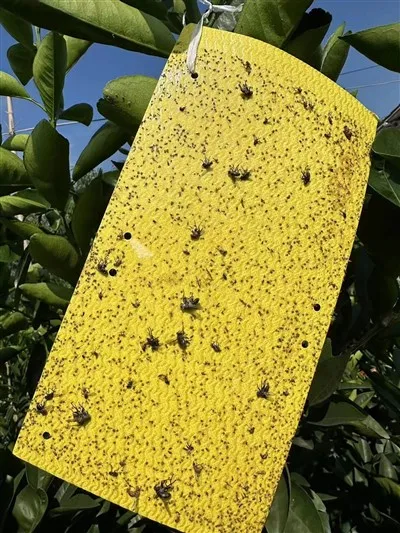
Physical and chemical trapping: Utilize the chemotaxis of adult insects by using poison bait and sex pheromones. Sugar-vinegar solution can be used to trap adults. Use fruit fly sex pheromones in conjunction with traps, hanging 45-75 traps per hectare at a height of 1.2-1.5 meters above the ground, replacing the bait cores monthly. Hang fruit fly traps to kill adults; increase the density appropriately in severely infested areas. In large-scale planting areas, frequency-vibration insecticidal lamps should be installed for light trapping.

Pesticide application: Spray treatments at midday or dusk during peak adult activity. Choose biopesticides such as cyromazine, abamectin and matrine, or synthetic options like lambda-cyhalothrin.
Reference Sources
National Agro-Tech Extension and Service Center pest monitoring bulletins; NY/T 3007-2016 Control Specification for Melon Fly; regional field survey data from plant protection stations of southern provinces; academic research on melon fly pesticide resistance, occurrence patterns and yield loss assessment; quarantine pest literatures on global distribution and transmission routes of Bactrocera cucurbitae.