The Chinese citrus fly (Bactrocera minax), commonly known as citrus maggot, belongs to the Tephritidae family of Diptera. It is a globally regulated quarantine pest and one of the most destructive insect threats to China's citrus industry.
It is widely distributed across Hubei, Hunan, Sichuan, Chongqing, Guizhou, Yunnan, Guangxi and Shaanxi in China. Overseas populations exist in India, Bhutan, Vietnam, Nepal and other regions. Its larvae bore and feed inside fruit segments, destroying pulp sacs and rendering fruit completely unmarketable. Severe outbreaks can lead to total crop failure.
Quick identification: Adults are pale tawny, measuring 10-13 mm in body length with a wingspan of 20-24 mm. They feature large metallic golden-green compound eyes. The mesonotum bears a teardrop-shaped yellow marking at its center, flanked by one vertical yellow stripe on each side; the scutellum is fully yellow. Wings are transparent with light tan coloration along the leading edge and a brown blotch at the wing tip.
Eggs are milky white and elongated oval. Fully mature larvae are maggot-shaped, creamy white to pale yellow, 15-19 mm long. Pupae are barrel-shaped and yellowish brown.

This pest exclusively targets citrus trees, including satsuma mandarin, ponkan, unshiu orange, sweet orange, pomelo and tangerine. After emergence, adult flies feed on honeydew and pollen from wild trees surrounding citrus orchards. Once eggs hatch, larvae tunnel through fruit flesh. Infested fruit ripen prematurely with red-tinged yellow discoloration, drop early and rot severely.
The Chinese citrus fly remains a severe persistent threat to citrus-growing regions along the upper and middle Yangtze River and across Southwest China. Based on aggregated 2026 field monitoring data analyzed by the National Agro-Tech Extension and Service Center, the pest reaches moderate occurrence nationwide this year, with a baseline affected area of 340,000 hectares. Integrated expert consultations covering seven core production zones (Sichuan, Chongqing, Hunan, Hubei, Guangxi, Yunnan, Guizhou) estimate a maximum potential infestation area of 360,000 hectares, marking sustained heavy pest pressure for consecutive years.
Per national unified green citrus fly control guidelines, mandatory control targets are set as follows: over 90% coverage for infested fruit removal and adult trapping; green pest control technologies including traps, sticky bait balls and food attractants applied across over 80% of citrus acreage; overall integrated control efficiency above 85%; and yield loss from pest damage kept below 5%.

All prevention and management follows the core principle of prevention first with integrated control, supported by zoned management, categorized treatments and cross-region joint prevention. Technical standards are sourced from official control plans and field monitoring guidance issued by local agricultural departments and plant protection stations.
Agricultural and ecological regulation
The Chinese citrus fly completes only one generation annually and overwinters as diapausing pupae underground. From late September to late November, collect fallen infested fruit and prematurely yellow damaged fruit on trees every 7 days; during peak infestation, increase frequency to once every 1-2 days. Gather affected fruit into dedicated sealed pest disposal bags to suffocate larvae. After 7-10 days of decomposition, bury the fruit deep underground as organic fertilizer. Orchards with suitable conditions can adopt cover cropping to optimize the microenvironment and support natural enemy populations.
Adult trapping
The optimal window for trapping is between adult emergence and egg-laying activity, from late April through early July. Regularly track adult emergence levels in orchards and deploy trapping measures promptly.
Fly trap ball: Hang 200–300 fly trap balls per hectare on the inner mid-canopy of citrus trees. For orchards with heavy pest history, place one ball on every 1–2 trees. Fully biodegradable fly trap balls are highly recommended.


Lure Poisoning with Food Attractant: Apply either 0.05% spinosad concentrated bait or 0.1% abamectin food attractant, spraying at 150 points per hectare , each point covering 0.5 square meters. Spray on the undersides of leaves in the lower and middle canopies, once every 7 days, generally 4-6 times.

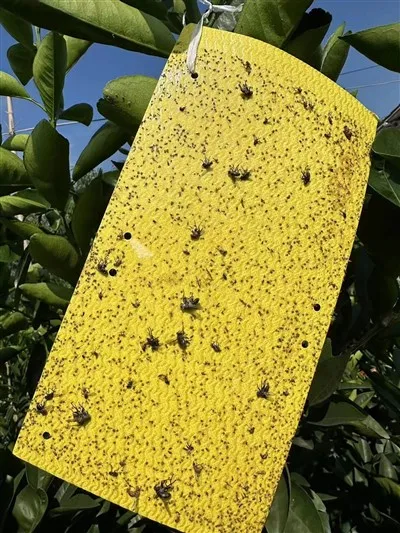
Yellow sticky trap: Hang 300-450 fully biodegradable yellow sticky traps with attractants per hectare , replacing them every 30 days.

Treatment of Infested Fruit and Fruit Bagging
Collect fallen fruit from mid-September to late November every 2-3 days, or daily during peak damage. Remove all damaged fruit still attached to branches. Carry out fruit bagging on sunny days. Thin excess leaves around fruit stems or clusters before bagging, and apply one round of insecticide if needed.
Reference Sources
2026 national citrus pest monitoring & comprehensive analysis report from National Agro-Tech Extension and Service Center; field survey data and joint expert prediction reports of Chinese citrus fly from seven major citrus producing provinces (Hunan, Hubei, Sichuan, Chongqing, Guangxi, Yunnan, Guizhou); national unified green prevention and control technical specifications for quarantine fruit flies; official annual integrated pest management schemes released by local agricultural bureaus and plant protection stations; Agricultural Industry Standard NY/T 3549-2020 Technical Code of Practice for Management of Bactrocera minax.