The red palm weevil, also known as the rusty palm weevil, belongs to the family Curculionidae of the order Coleoptera. It is an important national forestry quarantine pest in China and is listed in the Catalogue of Quarantine Pests for Imported Plants, classified as a major invasive alien insect. The larvae are 40-45 mm long, yellowish-white with dark reddish-brown heads, fat and spindle-shaped. The adult head extends into a distinct rostrum. Male adults have thick, straight rostrums covered with a cluster of setae on the dorsal side, while female adults feature slender, curved rostrums with two rows of small black spots. The adult abdomen shows alternating black and reddish coloration.

Native to South Asia, the red palm weevil spreads short distances through adult flight and disperses over long distances via the transportation of infected seedlings. It is widely distributed in Hainan, Guangdong, Guangxi, Fujian, Yunnan and southern Zhejiang. In southern tropical regions, it produces 2–3 overlapping generations per year. Characterized by strong concealment, its early damage is extremely difficult to detect. Adults prefer to lay eggs on plant wounds, petiole gaps and growth points. Larvae bore and feed inside trunks throughout their development, consuming stem parenchyma and growing tissues and forming dense, crisscrossing tunnels. Infected palms show no obvious external symptoms at the early stage. When heart leaves wilt and foliage turns yellow and collapses, the internal trunk is usually completely hollowed out, making the plant almost impossible to rescue.

Its host range includes coconut, areca nut, oil palm and various other palm plants, and it also infests sugarcane in some regions. The pest causes the most severe damage to 3-15-year-old young trees, while older mature trees are less susceptible. According to the areca nut orchard monitoring bulletin issued by the State Farm Administration of the Ministry of Agriculture and Rural Affairs, the average monthly number of trapped adults surges from 45 to 73 during outbreak periods, reflecting rapid population growth and high diffusion risks. Relevant journal studies have calculated that a field infection rate of 1%-5% will cause direct economic losses of USD 51,800 to 259,200 annually merely from felling and removing infected plants, seriously threatening tropical cash crop production and urban palm landscape industries. Severely infested trunks are filled with insect frass and tunnels, resulting in necrotic growth points, withered heart leaves and hollow, break-prone trunks. The pest spreads cross-regionally through infested seedlings and easily causes large-scale clustered disasters.

Integrated Pest Control Technologies (Based on NY/T 2815-2015 and DB46/T 310-2015)
Strictly implement seedling transportation quarantine and prohibit the introduction of pest-infested palm seedlings. Keep incisions flat during seedling transplantation and pruning to reduce mechanical wounds. Timely coat and seal wounds caused by wind damage and pruning with medicinal mud to block adult oviposition sites. Conduct regular field inspections and check trunks closely for the characteristic rustling sound of larval boring. Promptly fell, crush or deeply bury severely hollowed and unrecoverable plants to completely eliminate pest sources and prevent outward diffusion.
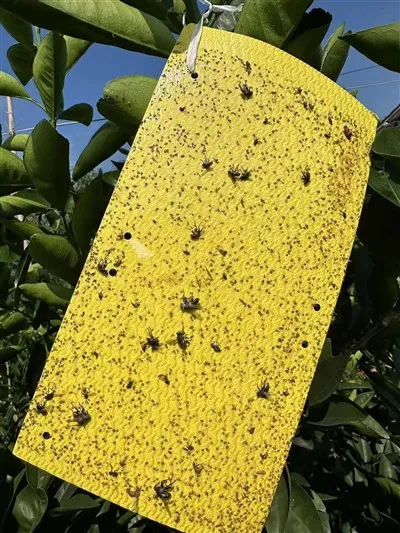
Deploy red palm weevil aggregation pheromone traps in planting areas, with one set of trapping devices per hectare, and regularly clean trapped pests. Sugarcane segments and pineapple tissue can also be used as food attractants for auxiliary adult trapping. Protect field natural enemy resources and sustainably conserve and attract beneficial birds to assist ecological pest suppression.

Adopt trunk injection treatment. Drill 7-10 cm deep holes at a 45° angle 50 cm above the ground, inject 5-10 times diluted 5% Imidacloprid suspension or 2% Thiacloprid Microcapsule suspension, and seal the holes with mud after injection. Repeat the treatment every 30 days for 2-3 consecutive times. Apply pesticides at the base of heart leaves during the initial and peak adult emergence periods. Select Thiamethoxam, Imidacloprid and Emamectin Benzoate, and conduct high-pressure canopy spraying until liquid drips evenly from foliage. Rotate pesticides with different modes of action to delay pesticide resistance. Strictly comply with pesticide safety interval regulations and avoid arbitrary dosage increase.
Data Sources
This technical guide is formulated based on agricultural industry standard NY/T 2815-2015 and local standard DB46/T 310-2015, combined with orchard pest monitoring data from the Ministry of Agriculture and Rural Affairs and published academic research on economic losses caused by red palm weevil infestation.