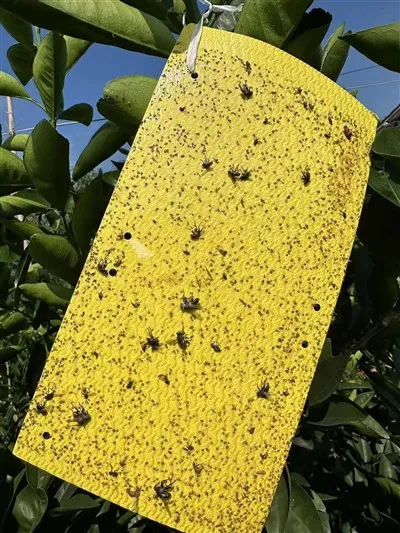
The loquat psyllid is a major pest of loquat cultivation, belonging to the Psyllidae family under Hemiptera. In recent years, with the continuous expansion of loquat planting scale and variety renewal across China, this pest has upgraded from a secondary insect pest to a dominant destructive species. It widely occurs in major loquat producing areas including Zhejiang, Yunnan, Sichuan, Anhui and Guizhou, with steadily worsening annual damage. In 2023, a new psyllid species Cacopsylla ochrocellata was identified in Zhaotong, Yunnan. Collectively referred to as loquat psyllid in field management, this newly discovered species reflects the complexity of field psyllid populations and raises higher requirements for standardized orchard pest prevention.
Quick Identification: Adults are small, approximately 2.8-3 mm in length, yellow-to-orange with transparent wings marked with black patches. They feature a pointed head and bodies covered with waxy powder. Nymphs are pale yellow, flat-oval and smaller in size, usually feeding in concealed aggregations. Eggs are mango-shaped and orange-yellow, scattered individually in tender shoots, bud crevices and young tissue gaps, making them difficult to detect.

Damage Characteristics: Both adults and nymphs inflict damage by piercing-sucking feeding, mainly attacking loquat buds, young leaves, tender shoots, flower panicles and young fruits. Adults are capable of migration and jumping, while nymphs hide on young shoots, bud bases, petioles and flower clusters to suck plant sap. Infested leaves exhibit twisted veins, crinkled surfaces, necrotic spots and progressive blackening, which further triggers sooty mould and premature leaf drop. Damaged flower panicles wilt, rot and die off. Attacked young fruits develop malformations covered with black mould stains caused by pest secretions, severely lowering yield and commercial fruit value. Two prominent nymph damage peaks occur during the flower-panicle stage and young-fruit stage.

Occurrence Patterns: Annual generations vary geographically: 5-6 generations in Qiandaohu reservoir area of Zhejiang; 5-7 generations in Zhaotong, Yunnan; 6-7 generations in Honghe, Yunnan. Severe generational overlap is observed in field conditions. Generally two population peaks emerge annually, in early-mid April (spring) and early-mid November (autumn). For Zhaotong, Yunnan, peaks fall between February-June and August-November. Optimal developmental conditions are temperatures of 11-26℃ and relative humidity 55%-100%. Minimum temperature, average temperature and precipitation from December to February of the prior year correlate with pest pressure in the following growing season. Eggs, nymphs and adults can overwinter locally; overwintering adults mostly shelter in bark crevices, tree hollows, fallen weeds, leaf litter and soil fissures.
Integrated Management Strategies: Control measures comply with the local standard DB5306/T141-2021 Technical Regulation for Control of Cacopsylla ochrocellata. Adhering to the plant protection principle of prevention first and integrated management, the system integrates agricultural, physical, biological and chemical technologies to achieve scientific, green and efficient loquat psyllid control.
Agro-ecological pest suppression: Optimize orchard water and fertilizer management, prioritize organic fertilizer application and strictly control nitrogen fertilizer dosage to cultivate robust tree vigor and improve tree stress resistance. Timely remove fallen leaves, residual branches and diseased debris, and conduct shallow soil tillage around tree disks during fertilization to destroy overwintering habitats and cut down pest bases. Optimize orchard layout and avoid intercropping or mixed planting with peach, pear and citrus trees to reduce cross-infestation risks. Conduct targeted pruning after fruit harvest to thin weak, dense and overgrown branches. And spray a 1°Bé solution of lime-sulfur in May to effectively eliminate pathogens and pests.

Physical-chemical trapping and monitoring: Utilize the yellow-trapping preference of loquat psyllids for physical control. Hang 300–450 yellow sticky traps per hectare at 1.2–1.5 meters on the upper and middle canopy. Yellow sticky traps can effectively capture adult Cacopsylla ochrocellata while generally having a relatively lower impact on beneficial insects, making them suitable for use during the adult activity period. Install frequency-vibration insecticidal lamps in well-equipped orchards to assist adult trapping and reduce field pest density. Conduct regular field inspections. The optimal control period starts when 10%–20% of shoots are infested from full flower axis expansion to early blooming stage.

Biological control: Protect natural enemies including lacewings, ladybugs and parasitoid wasps to maintain orchard ecological balance and reduce chemical pesticide usage. Prioritize green biological and botanical pesticides under low pest density conditions. Effective formulations include 0.5% matrine aqueous solution (1000-fold dilution), 25% thiamethoxam water dispersible granules (2500-fold dilution) and azadirachtin emulsifiable concentrate. These agents feature stable control efficacy and low residue, fully meeting green fruit production standards. The combination of natural enemy conservation and biological pesticides builds a sustainable ecological pest suppression system.
Targeted chemical control: Focus on two core control windows: pre-blooming and blooming stages (September-December), and pre-fruit bagging stages (February-March of the next year). Conventional orchards can adopt compound pesticides such as abamectin combined with spirotetramat-thiamethoxam or fenoxycarb-buprofezin. For greenhouse loquat cultivation, apply 75g/L abamectin-biflupyrazoxam DF at a dosage of 15 mL per mu with water dilution. Target uniform spraying on pest-concentrated positions including tender shoots, flower spikes, leaf undersides and bud crevices. Rotate pesticides with different action mechanisms to prevent resistance caused by single-agent long-term application. Cooperate with yellow sticky traps after blossom fall to enhance comprehensive control effects. Strictly abide by pesticide pre-harvest intervals and standardized application specifications to ensure loquat fruit quality and orchard ecological safety.
Data Sources:
Local Standard DB5306/T141-2024 Technical Regulation for Control of Cacopsylla ochrocellata;
National loquat pest occurrence monitoring data;
Yunnan Zhaotong regional new pest species identification research;
Integrated orchard pest prevention and control technical specifications.