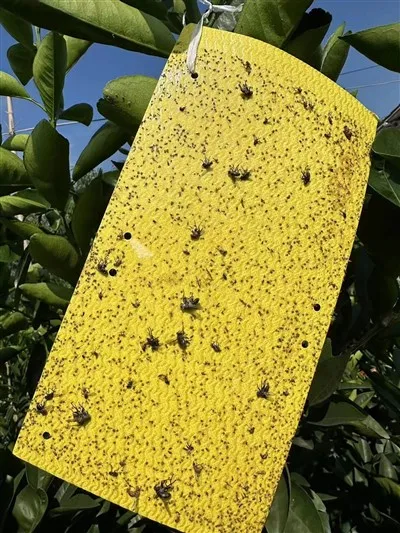
The Spodoptera litura is a major recurring native pest across all agricultural regions of China. It is characterized by its omnivorous diet, rapid reproduction, voracious feeding behavior, and intermittent outbreaks, with concentrated outbreaks occurring during the hot and humid summer and autumn seasons. Adult moths have greyish-brown forewings marked with three distinct white diagonal stripes running from the front to the rear edge. Larvae come in many colour variations dotted with tiny pale spots, each body segment carrying triangular black blotches, with the largest spots on the 1st, 7th and 8th abdominal segments.

This pest targets over 290 plant species spanning 99 families, with brassica vegetables, beans, sweet potatoes, cotton and maize suffering the worst damage. Young larvae cluster together to eat leaf tissue, leaving translucent burnt-looking spots. Once they reach the 4th instar, they enter a heavy feeding phase, consuming entire leaves, tender shoots and even crop fruits.
The 2026 pest forecast released by China's National Agro-Tech Extension and Service Center predicts infestations will cover 3.6 million hectares of soybean nationwide, with severe pressure hitting mixed maize-soybean farms in the Huang-Huai-Hai Plain. In Fujian Province, autumn outbreaks typically spread across 44,000 hectares, with severe plots holding thousands of larvae per hectare.
In August 2024, in the contiguous sweet potato producing areas of Henan, Shandong, and Anhui provinces, 27,500 hectares out of 85,000 hectares of summer-planted sweet potatoes were affected by pests, with 7,800 hectares severely affected. The pest infestation rate in severely affected fields reached 72.3%, exceeding the Level III threshold for emergency control. After joint aerial spraying, over 2.2 billion yuan in yield losses were saved. The third generation of this pest hit vegetable fields in Suzhou, Jiangsu in 2024, where 25.2% of plants showed feeding damage. Widespread infestations broke out across vegetable, sweet potato and bean plots in Fengjie, Chongqing in 2025, prompting local emergency intervention to stop further spread.
According to monitoring by the national plant protection system, in years with moderate outbreaks of the Spodoptera litura, crop yields can be reduced by 10%-30%, and in severely affected areas, yields can be reduced by more than 50%, with some fields experiencing total crop failure. Moreover, the insect develops resistance to pesticides rapidly, reducing the effectiveness of conventional pesticides and making control increasingly difficult.

All control measures follow the core principle of integrated management to suppress pest numbers early and limit later outbreaks, aligned with official guidance from the National Agro-Tech Extension and Service Center's Technical Guide for Spodoptera litura Control and pesticide application regulations issued by the Ministry of Agriculture and Rural Affairs.
Control pests at the source in agriculture
After crop harvesting, deep plow and turn the soil to a depth of more than 20 cm to destroy the pupal chambers and kill overwintering and oversummering pupae in the soil; during the adult oviposition period, manually remove egg masses on the back of leaves and leaves where young larvae gather, and take them out of the field for destruction, directly reducing the population base of the next generation of pests.
Physical and chemical methods to kill adult insects
Pheromone trapping: During the adult emergence period , deploy 15 sex traps per hectare , 20 cm above the crop canopy. Replace the special lures every 30 days to target and kill male insects , thereby reducing the number of eggs laid in the field.
Light trapping: Deploy one frequency-vibration insecticidal lamp per 2-3 hectares in contiguous planting areas . Turn on the lamps from 20:00 at night to 6:00 the next day to concentrate on killing adult insects.

Prioritize biological control
Apply biological agents from peak egg hatching through the 1st and 2nd larval stages. Options include Spodoptera litura nuclear polyhedrosis virus suspension and Bacillus thuringiensis wettable powder, sprayed evenly over both sides of crop leaves. Carry out applications in the evening or on cloudy days, with a second top-up spray after seven days. This method suppresses pest populations while protecting beneficial natural insects.

Apply pesticides scientifically and in accordance with standards
Control threshold: Start applying pesticides when the number of insects per 100 plants of cruciferous vegetables reaches 5 and the number of insects per 100 plants of field crops such as sweet potatoes reaches 10. Select registered pesticides such as chlorantraniliprole, indoxacarb, and chlorfenapyr, and spray the undersides of leaves and the middle and lower parts of the plants in the evening. Rotate pesticides with different mechanisms of action, and do not apply a single type of pesticide more than twice per crop season to delay the development of pesticide resistance in pests.
Data & Technical References
National Agro-Tech Extension and Service Center 2026 Pest Forecast, Technical Guide for Spodoptera litura Control, Ministry of Agriculture and Rural Affairs pesticide application standards, provincial plant protection station field monitoring records (2024–2025)