Fall armyworm (Spodoptera frugiperda) originates in tropical and subtropical zones across the Americas. The FAO classifies it as a high-priority transboundary migratory pest, and China added it to its Category I regulated crop pest list back in 2020. Males and females are easy to distinguish by wing appearance: males have dark brown forewings capped with a tuft of grey tail-like scales. Two reliable markers identify larvae: a pale inverted "Y" line on their head capsule, plus four evenly spaced square black blotches on the top of their eighth abdominal segment.

This pest feeds on more than 350 plant species including maize and wheat, yet maize sustains the worst damage. It eats aggressively once established, typically cutting crop yields by 20–30%; unmanaged heavy outbreaks can wipe out entire harvests. The pest first landed in Yunnan Province, China, in January 2019. It spread rapidly to 25 provincial regions within the same year, with pest activity recorded across over 1 million hectares and severe damage spanning 164,000 hectares. More than 80% of all affected land sat in the country's southwestern provinces.

Surveillance figures published in June 2026 by China's National Agricultural Technology Extension Service Center forecast national fall armyworm activity will cover 2 million hectares this year. Damage will follow a clear north-south split: southern growing regions face far heavier pressure, while northern areas see milder infestations. As of early June, confirmed outbreaks covered 320,000 hectares across 396 counties in 13 provinces. Larval numbers observed in fields are roughly 20% lower than the multi-year average for this time of year.

Recent field cases illustrate just how destructive this pest can be. In July 2025, summer maize fields in Wuxuan County, Guangxi saw severe infestation, with 75% of stalks showing feeding damage and peak counts hitting 132 larvae per 100 plants. That same month, 6% of maize plots in Shangnan County, Shaanxi tested positive for the pest, creating clear risks of further northward spread. Going back to the initial invasion in 2019, winter maize fields across 11 Yunnan counties recorded 448 hectares of damage within the first month alone, which immediately triggered China's national emergency pest response protocol.
Economic modelling conducted by the Institute of Plant Protection, Chinese Academy of Agricultural Sciences estimates annual potential losses to China's maize industry would reach RMB 37.5–330.6 billion without intervention. Years of coordinated nationwide pest management have brought total annual crop losses down to a steady 5% or less, recovering around 5 to 6 million tonnes of maize each growing season.
China's core management principle focuses on early, small-scale treatment to stamp out pest populations before they surge.
Surveillance & Early Warning
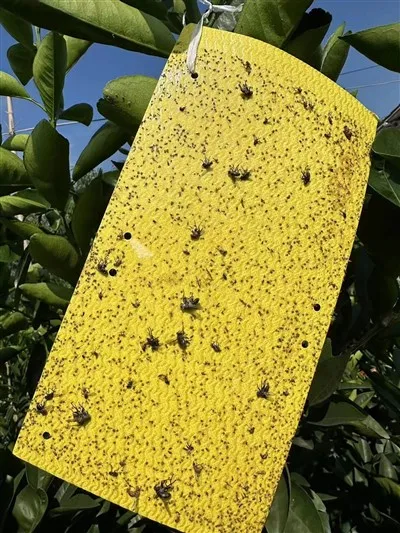
Farm crews place one pheromone trap every 2–3.3 hectares, with denser setups along migratory entry zones. Lure inserts get replaced every 30 days. Major maize-growing zones also install high-altitude light traps to track real-time moth migration patterns. Teams scout fields every five days, checking maize whorls and leaf undersides for egg masses and young larvae. Official guidance sets the intervention threshold at 10 larvae per 100 plants; treatment works best during the first and second larval instars.

Physical & Lure-Based Population Suppression
When adult moth numbers peak, solar-powered insect lamps are spaced 80–100 metres apart and run overnight to trap migrating adults. Growers also deploy 15 to 30 pheromone or food lure stations per hectare to catch both male and female moths. This cuts egg-laying activity across fields at the source and reduces the workload of later larval treatments.

Biological, Low-Impact Control Practices
Farmers release Trichogramma egg parasitoid wasps in two to three separate batches. Each release adds 150,000–300,000 wasps per hectare, with a 5–7 day gap between releases. Once young larvae appear, growers apply microbial pesticides such as Bacillus thuringiensis and Beauveria bassiana, targeting the inner maize whorl. Spraying takes place on cloudy days or in early evening to preserve beneficial predatory insects while boosting product performance.
Targeted, Responsible Chemical Application
Once larval counts cross the 10-per-100-plants threshold, farmers apply government-approved insecticides including chlorantraniliprole and tetrachlorantraniliprole, spraying directly into maize whorls in the early morning or late afternoon for optimal coverage. Large connected growing areas carry out unified community pest control. To slow the development of pesticide resistance, growers rotate active ingredients with different working mechanisms, and no single chemical group is used more than twice within one full growing cycle.
Data source:
Ministry of Agriculture and Rural Affairs P.R.China. Announcement No.333, 2020. List of Class I Crop Pests.
National Agro-Tech Extension and Service Center. Pest Situation Bulletin of Spodoptera frugiperda, June 8, 2026.
Institute of Plant Protection, CAAS. Potential Economic Loss Assessment of Maize Industry Damaged by Fall Armyworm, 2026.
NY/T 3865-2020. Technical Specification for the Control of Spodoptera frugiperda.
CABI. Spodoptera frugiperda datasheet, Invasive Species Compendium.
FAO. Global Action for Fall Armyworm Control Transboundary Pest Assessment Report.
Montezano D G, et al. Host plants of Spodoptera frugiperda, 2018.