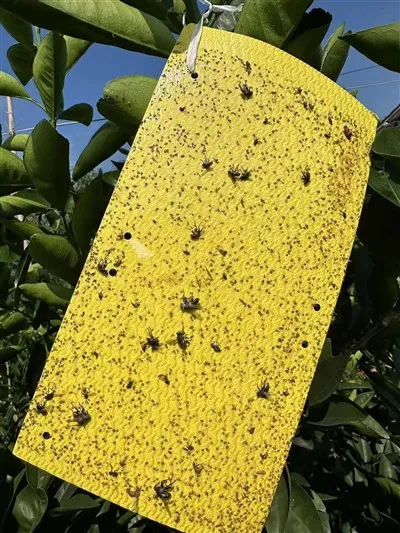
A field demonstration conducted in a commercial citrus-growing area has validated the performance of a pheromone-based sticky trap board for early detection of Asian citrus psyllid, the primary vector of citrus greening disease. The demonstration compared a combined citrus psyllid pheromone lure and sticky board system with conventional yellow sticky traps under real orchard conditions.
The results confirmed that adding species-specific pheromone lures to sticky boards significantly improved target pest recognition while reducing the capture of non-target insects. This improvement lowers the labor required for manual sorting and counting, making monitoring programs more efficient for citrus growers and plant protection technicians.
Why Citrus Psyllid Monitoring Matters
Citrus greening, also known as Huanglongbing (HLB), remains one of the most serious threats to citrus production worldwide. There is currently no cure for infected trees. Once a tree is infected, production declines and the tree eventually dies. Because direct treatment options are limited, early detection of the psyllid vector is widely recognized as the most practical first line of defense.
Traditional yellow sticky traps rely solely on color attraction. While they are inexpensive and easy to deploy, they capture a broad range of flying insects. In citrus orchards, this often means that large numbers of non-target insects appear on the trap surface, making it difficult and time-consuming to identify and count citrus psyllids accurately.
By adding a citrus psyllid-specific pheromone lure, the sticky board becomes more selective. The pheromone attracts adult psyllids to the trap, while the yellow color continues to provide general visual attraction. The sticky surface then captures and retains the insects for later counting. This combination supports more accurate population monitoring and earlier detection of psyllid movement into orchard blocks.
Field Demonstration Focus
The demonstration was conducted under normal orchard management conditions. The pheromone sticky trap boards were hung at standard monitoring height and checked at regular intervals. Key observations included:
The pheromone + sticky board system captured a higher proportion of citrus psyllids relative to total catch compared with yellow sticky traps alone.
Non-target insect capture was visibly reduced, simplifying on-site inspection and counting.
Waterproof substrate boards maintained physical integrity during periods of heavy rain and high humidity, with less warping, delamination, or adhesive loss than conventional boards.
The waterproof substrate was an important factor in rainy-season performance. In many citrus-growing regions, frequent rainfall and high humidity can quickly degrade standard sticky boards. The field demonstration showed that boards with waterproof base material retained their capture surface and remained readable for a longer period under wet conditions.
Monitoring, Not Mass Trapping
The pheromone sticky trap board is designed primarily as a monitoring tool rather than a mass trapping device. Its main value is to provide early warning of psyllid presence and population trends, enabling growers to make informed integrated pest management decisions.
When psyllid numbers increase above locally established thresholds, growers can respond with targeted actions such as regional coordinated sprays, biological control releases, or more intensive monitoring. The goal is not to eliminate every insect with sticky boards, but to detect migration and population buildup before HLB transmission risk rises.
Compatibility with IPM and Digital Monitoring
The pheromone sticky trap board can be used as a standalone monitoring method or in combination with other pest forecasting tools. In orchards where AI pest monitoring systems or agricultural IoT platforms are deployed, regular sticky trap counts provide valuable ground-truth data to validate automated image recognition results. The two approaches are complementary: digital systems provide continuous remote monitoring, while pheromone sticky boards offer a simple, low-cost, and highly specific method for tracking vector species.
This field demonstration is part of Ruijinte's ongoing effort to validate practical green pest control tools under real agricultural conditions. The company continues to evaluate the performance of pheromone lures and sticky trap products across different crop systems and climate zones.