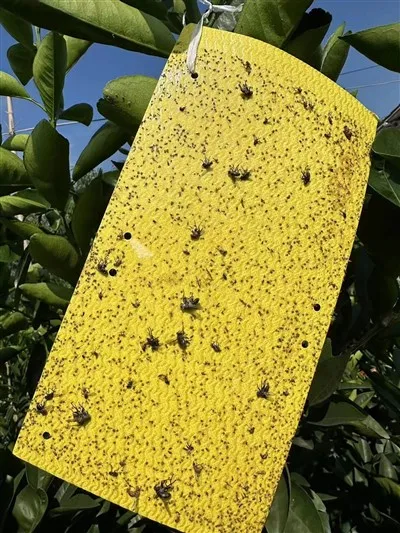
Ruijinte has completed a multi-scenario evaluation of sticky trap products for flying pest monitoring in greenhouses, nurseries, and open-field orchards. The evaluation compared different sizes of double-sided sticky boards and waterproof sticky cards for monitoring common pests such as flies, thrips, and small flying insects.
The trials were conducted under contrasting environmental conditions: high-humidity greenhouse structures, UV-exposed open fields, and shaded nursery areas. The goal was to provide practical selection guidance for growers and plant protection technicians who need reliable, low-cost monitoring tools that fit their specific crop and climate conditions.
Why Sticky Traps Remain a Core Monitoring Tool
Sticky traps are among the most widely used physical monitoring tools in agriculture and horticulture. They are simple to install, do not require power, and provide immediate visual records of pest presence. For organic farms, export-oriented vegetable bases, and nurseries where chemical pesticide use is restricted or carefully managed, color-based sticky trapping is often a first-choice monitoring method.
However, not all sticky traps perform equally in every environment. Greenhouse conditions with high relative humidity can cause standard paper-based boards to soften, warp, or lose adhesive strength. Open-field conditions with strong sunlight can degrade non-UV-stabilized materials quickly. Trap size and placement also influence capture efficiency and ease of counting .
.
Evaluation Focus
The evaluation covered three main product categories:
- Double-sided sticky boards – Suitable for small flying pests such as whiteflies, thrips, and fungus gnats. Double-sided capture surfaces increase trapping area without requiring additional hanging points.
- Waterproof sticky cards – Designed for high-humidity greenhouse zones and rainy-season outdoor use. The waterproof base material reduces deformation and adhesive failure under moisture stress.
- Multi-size sticky traps – Different dimensions were assessed for varying pest pressure levels. Smaller traps fit narrow nursery benches and seedling areas, while larger boards are more appropriate for open-field rows and perimeter monitoring.
Field and greenhouse observations showed that waterproof sticky cards maintained better physical stability and adhesive performance in humid environments than standard paper-based boards. In open-field conditions, traps with UV-stabilized materials retained color and adhesive quality longer under continuous sunlight exposure.
Matching Trap Size to Pest Pressure
One practical finding from the evaluation was the importance of trap size relative to insect population density. In low-pressure greenhouse areas, smaller boards provided sufficient monitoring sensitivity and were easier to inspect. In high-pressure field zones, larger boards captured more insects without becoming saturated too quickly, allowing longer service intervals and more meaningful count data.
For growers monitoring thrips or small flies, double-sided boards increased the chance of catching insects approaching from different directions. For orchard perimeter monitoring, larger yellow sticky cards offered better visibility and were easier to check from a distance.


Greenhouse vs. Field: Different Requirements
Greenhouse environments present unique challenges. High humidity, frequent irrigation, and dense plant canopies create conditions where standard traps may fail prematurely. Waterproof sticky cards are particularly valuable in propagation houses, hydroponic facilities, and tropical greenhouses where condensation is common.
Open-field orchards and vegetable fields face different stressors. UV radiation, wind, dust, and rain can all reduce trap effectiveness. In these settings, material durability and weather resistance are just as important as color attraction.
Standardizing Green Physical Pest Monitoring
The evaluation supports a practical approach to green pest control: selecting the right sticky trap for the right environment and pest target. Sticky traps are not intended to eliminate pest populations. Their role is to provide reliable, low-cost monitoring data that supports integrated pest management decisions, such as when to introduce biological control agents or apply targeted interventions.
Sticky traps are also frequently used together with pheromone lures. While yellow or blue color attracts a broad range of flying insects, species-specific pheromone lures increase selectivity for key pests. This combination is particularly useful for vector species and quarantine pests that require precise population tracking.
Ruijinte will continue to evaluate sticky trap performance across different crops and climatic conditions. The findings contribute to more standardized, practical physical monitoring programs for greenhouses, nurseries, and field production systems.