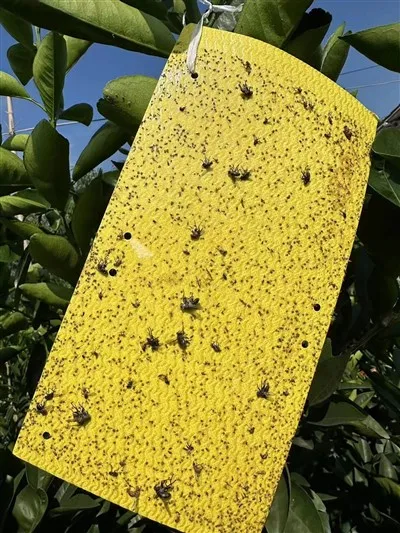
As an efficient and environmentally friendly physical pest control tool, sticky insect traps play a vital role in global agricultural production. They capture pests with a special sticky material, reducing the use of chemical pesticides and aligning with the sustainable development of modern agriculture, thus attracting widespread attention in the international market.
The core principle of sticky insect traps is to leverage the insects' phototaxis, color attraction, or chemotaxis, combined with a highly sticky surface, to achieve targeted capture of target pests. Common types include yellow sticky boards, blue sticky boards, and traps with lure cores for specific pests. Yellow sticky boards are particularly effective against small flying insects such as aphids and whiteflies, while blue sticky boards are commonly used to control thrips. Furthermore, some high-end products incorporate pheromone lures to precisely target specific pests, such as fruit flies or stored-goods pests, significantly improving control efficiency.
Demand for sticky insect traps continues to grow internationally, particularly in organic farming and organic plantation. Strict restrictions on the use of chemical pesticides in regions such as the European Union, North America, and Australia have prompted farmers to turn to physical pest control methods. Sticky insect traps are a preferred solution in these markets due to their pollution-free, reusable (for some types), and easy-to-use features. Furthermore, with the increasing emphasis on quality and safety in the global agricultural trade, sticky insect traps play a key role in pest control during storage and transportation, effectively preventing cargo damage and trade risks caused by pests.
From a foreign trade perspective, sticky insect traps have enormous export potential. Their production process is mature, raw materials are readily available, and they are adaptable to the agricultural needs of different countries and regions. Suppliers can customize their products based on the pest species and growing environments of target markets, such as adjusting the color and size of the sticky plates or the lure formula. Furthermore, with the deepening of cross-border e-commerce and agricultural technology cooperation, the promotion channels for sticky insect traps have been further expanded, providing new growth opportunities for foreign trade companies.
In the future, as global agriculture transitions towards greener and smarter agriculture, sticky insect traps are expected to see both technological advancements and market demand increase, making them a key product in the foreign trade industry, combining both practical value and commercial potential.