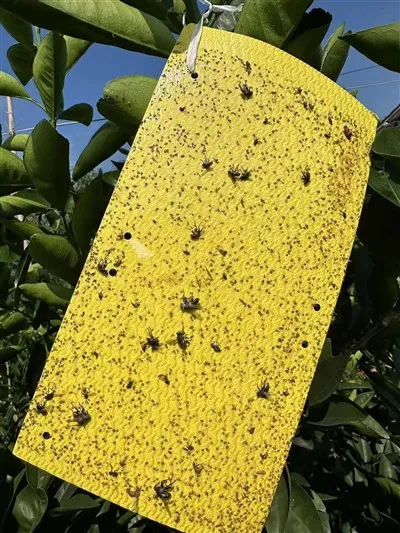
Citrus is a common fruit deeply loved worldwide. In 2025, China's citrus output exceeded 70 million tons (reported by People's Daily Online), accounting for one-third of global production, making citrus the most widely planted and highest-yielding fruit category in China. With such a huge output, what role can physical control play? As early as 2018, we conducted a preliminary exploration.

From March to October 2018, our company, together with the Agriculture and Rural Affairs Bureau of Qingshen County, Meishan City, and Sichuan Agricultural University, carried out a seven-month experiment. The experimental site was a 53-hectare citrus orchard with flat terrain, mainly planted with Ehime 38 and Harumi. Fifteen hectares were used as a blank control group, where the orchard owner applied conventional chemical control according to previous practices. The remaining 38 hectares were managed under an integrated control program: our company provided physical control products, and chemical control was applied under the guidance of experts from Sichuan Agricultural University. That is, when certain physical control indicators reached a threshold, chemical control was introduced. Since this is a preliminary exploration, the main objective is to select out the products with obvious effects from the numerous options. Some products may have no preventive or control effect at all. Timely chemical control intervention is a guarantee for the garden owner's yield.

For solar insecticidal lamps, we installed 26 units in total, using 13 types of insect-attracting light sources with different wavelengths. The orchard owner collected trapped pest samples twice a week, sealed them in bags marked with collection date and number, and stored them in a freezer. For sticky traps, we used 22 colors of sticky traps (20 cm × 25 cm, double-sided adhesive) and one type of pheromone sticky trap (methyl eugenol added to the adhesive, 38 cm × 22 cm, single-sided adhesive), placed evenly throughout the experimental area. Every week, the orchard owner recovered the used sticky traps, marked the recovery date, and placed new ones. For fruit fly ball traps, yellow and green were the main colors, also placed evenly throughout the experimental area. They also were recovered once a week, marked with the date, and replaced with new products. Our staff went to the orchard every week to take the samples collected by the orchard owner to the university laboratory, where professors identified and recorded all the data. In addition, teachers from the university regularly visited the orchard to observe and record pest conditions and to determine whether chemical pesticide intervention was needed.

After seven months, we summarized all the data. The roles of some products in citrus pest control gradually became clear. The effectiveness of yellow sticky traps against aphids(Aphidoidea) and whiteflies(Aleyrodidae) was once again confirmed, with peak catches of 573 and 308, far higher than the highest values for other colors (124 and 137). Among the various colors of sticky traps we used, 11 colors had peak thrips(Thripidae) catches above 200, with blue highest at 396 and pink at 337, significantly higher than other colors. For the Asian citrus psyllid(Diaphorina citri), the main vector of the devastating citrus disease Huanglongbing (HLB), green sticky traps were more suitable for control, with a peak of 486, while the highest peak among other colors was 73. Against the Chinese citrus fly(Bactrocera minax) and the oriental fruit fly(Bactrocera dorsalis), yellow and green sticky traps, pheromone sticky traps, and fruit fly ball traps all performed well. The peak catch of yellow sticky traps was 187, green sticky traps 143, and pheromone sticky traps 214. Yellow fruit fly ball traps had a peak of 32 and green fruit fly ball traps 27; on a per-unit-area basis, their trapping efficiency was higher than that of ordinary sticky traps of the same color, but the unit cost was much higher than that of sticky traps. Light traps did not show any outstanding performance in this experiment; the pests caught were all common pests, and no pests of major danger to citrus were captured.

After November, the orchard owner's citrus gradually began to enter the market, and this continued until February of the following year. The yield of the 15-hectare blank control group increased by 2.7% compared with previous years, indicating that all the objective conditions affecting the output remained unchanged from the previous year. The yield of the 38-hectare experimental area decreased by 3.6% compared with the previous year, mainly because in some areas where ineffective products were used, chemical control intervention was delayed after pest outbreaks occurred. Overall chemical pesticide use in the experimental area was reduced by 17.8% compared with the blank control group. The effective products achieved a certain degree of control effect, but further verification is still needed.

Although the overall effect of this experiment in reducing chemical pesticide use was not significant, its essence was a preliminary screening of candidate products and an exploration of control pathways. This seven-month attempt covering a 53-hectare orchard allowed us to accumulate valuable first-hand data and pointed the way for our subsequent in-depth exploration. Next, on the basis of summarizing this experience, we will focus on several products that showed actual trapping effects in the experiment, further optimize their application plans, set up more rigorous controls and replications, and carry out verification experiments across orchards, varieties, and years. We will scientifically evaluate their real control effects under the premise of stable yield and quality, and gradually form a replicable and scalable collaborative scheme combining physical control and chemical control for citrus, so as to provide a more reliable basis for reducing chemical pesticide use and improving green control levels in orchards.
FAQ
Q: What is the application rate of insect sticky traps in a citrus orchard?
A: For citrus and other fruit trees, use 1–2 traps per tree, hung in areas with sparse branches and leaves.
Q: How long can insect sticky traps be used?
A: Insect sticky traps can be used for more than 3 months in environments from -10°C to 70°C, and they remain sticky after rain. Unopened insect sticky traps can be stored in a cool place for more than 2 years. When pest infestation is severe, replace the traps promptly once they are covered with pests.
Q: What is the application rate of pheromone sticky traps?
A: The application rate of pheromone sticky traps is 120–180 traps per hectare.
Q: How long can pheromone sticky traps be used?
A: Pheromone sticky traps are usually used for 2–3 weeks. After the pheromone has completely volatilized, they can still be used as ordinary yellow sticky traps. Note: Unopened pheromone sticky traps must be stored in a cool place.