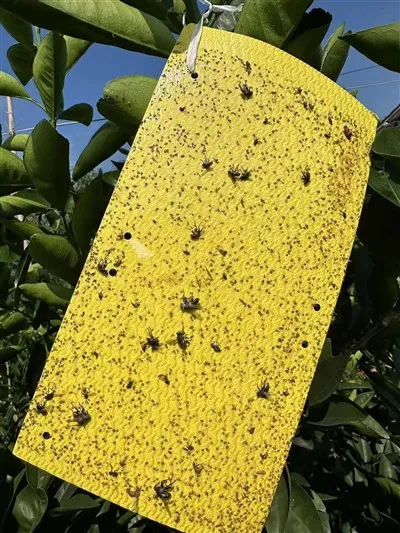
In agricultural pest control, sticky traps are an effective, environmentally friendly, and widely popular physical control tool for their ease of use and low cost. However, different types of sticky traps differ significantly in their design principles, applicable scenarios, and effectiveness. Understanding these differences is crucial for foreign trade practitioners to accurately meet client needs.
Based on material and structure, sticky traps are primarily categorized into three types: hanging, ground-mounted, and light-trap-equipped. Hanging sticky traps typically utilize yellow or blue plastic sheets coated with a highly viscous gel. Their color attracts specific pests (such as aphids and fruit flies) and are suitable for open environments such as orchards and greenhouses. Ground-mounted sticky traps are often funnel-shaped or box-shaped, leveraging the insects' phototaxis or chemotaxis to attract and trap them. They are commonly used in farmland or storage areas. Light-trap-equipped sticky traps, which combine a UV light source with a sticky sheet, are more targeted and are suitable for nocturnal moth pests. They are widely used in large-scale plantations.
The differences between different sticky insect traps are even more pronounced in terms of function and application scenarios. Yellow sticky boards are particularly effective against small flying insects like aphids and whiteflies, while blue sticky boards are more likely to attract thrips. Ground-mounted traps are more effective against underground pests like ants and mole crickets. Furthermore, some high-end sticky insect traps incorporate pheromones or plant essential oils as attractants to further enhance capture efficiency. These products are particularly popular among organic farmers in the international market.
For the foreign trade industry, understanding these differences can help recommend appropriate products based on the agricultural characteristics of target markets. For example, customers in tropical regions may prefer hanging sticky boards that target fruit flies, while temperate grain-producing regions may have a greater demand for underground pest traps. Furthermore, sticky insect traps with environmentally friendly solvent-free adhesives, which meet international environmental standards, are more competitive in the European and American markets.
In short, the differentiated designs of sticky insect traps reflect the trend toward precision agriculture. Foreign trade practitioners need to have a deep understanding of the characteristics of various products to provide clients with scientific and efficient solutions, thereby gaining an advantage in international competition.